
 YouTube Automation
How Video Editing Affects YouTube Algorithm in 2026 – 11 Powerful Tips (Blog#: 75)

Your video is not getting views, not because your content is bad, but because your editing is quietly hurting your YouTube algorithm signals in 2026. How Video Editing Affects YouTube Algorithm in 2026 is no longer just a technical topic; it is the difference between a channel that grows and one that slowly fades away.
In 2026, video editing has become the core driver behind the viewer satisfaction signals that the YouTube algorithm actually prioritizes. The algorithm does not watch your video like a human; it tracks how your editing shapes viewer behavior, especially retention, watch time, and how deeply people stay engaged. Most creators spend hours editing, but they do not realize that slow pacing, weak cuts, and poor structure actually push the algorithm away from their videos.
When you understand the 11 powerful signals that connect your editing decisions directly to algorithm reach, you gain a real advantage over creators who are still guessing. Keep reading, this article gives you a clear blueprint to stop editing blindly and start editing smart.
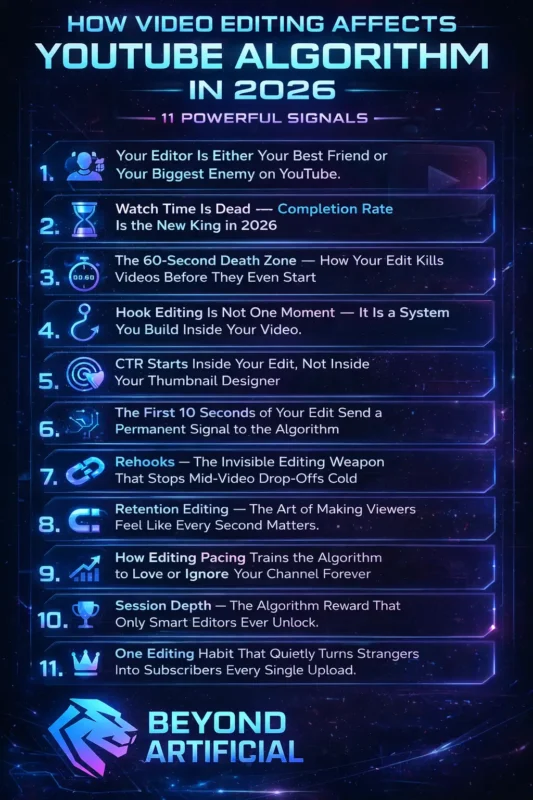
Before we go deeper, you need to understand how retention editing doubles your views, because this is the core signal the YouTube algorithm tracks in 2026.
1. Your Editor Is Either Your Best Friend or Your Biggest Enemy on YouTube.
Your video editor is not just a tool; it quietly decides whether your video gets pushed to people or ignored completely, and most creators do not realize this until it is too late. Every bad cut, slow intro, or messy transition signals to the YouTube algorithm that your content is not worth recommending, and it reacts instantly. The hard truth is this: your idea can be great, but poor editing can ruin it before viewers even get interested.
So here is what you should do. Always watch your final video at 1.5x speed before uploading. If you lose focus for even a second, viewers will lose interest even faster. Cut anything that does not add value. Slow moments and dead space are where people leave, and the algorithm notices every exit. After editing, ask yourself one simple question: Does every cut keep the energy moving forward, or is it slowing things down?
Because in the end, energy is what keeps people watching, not just information. When you start using your editor as a tool to improve retention (not just cut clips), your views, reach, and growth will naturally improve.
2. Watch Time Is Dead: Completion Rate Is the New King in 2026.
For years, you focused on making longer videos, adding filler, and hoping more watch time would help your channel grow. But by 2026, that strategy no longer works. In fact, it is hurting creators who still rely on it. Now, the YouTube algorithm doesn’t care about how long people watch; it cares if they finish the video, feel satisfied, and keep watching more content. A short 6-minute video with high completion can easily outperform a long 20-minute video with low retention.
That is why many creators feel stuck; they work harder, make longer videos, but still do not get results. Here is what you should do instead. Go to YouTube Studio and check your retention graph. Find the exact point where viewers start leaving; that is your real problem, and it usually comes from editing, not your idea. Cut everything before the value starts. Long intros, early sponsor messages, or unnecessary setup can push viewers away quickly.
Also, end your video at the right moment. Do not drag the ending, do not repeat what you already said, and avoid extra outro fluff. Deliver value, then stop. Because when you start editing for completion instead of length, your retention improves, your viewers stay satisfied, and the algorithm starts pushing your content more.
3. The 60-Second Death Zone: How Your Edit Kills Videos Before They Even Start.
The most painful moment for any creator is opening YouTube Studio and seeing a huge drop in retention before the first 60 seconds, because it means the algorithm has already decided your video is not worth pushing. In 2026, your first 60 seconds matter more than the rest of your video combined. If your editing does not grab attention, promise value, and give a reason to stay right away, your video struggles before it even begins.
The reality is harsh: more than half of viewers leave in the first minute, and most of the time, it’s not your idea that is the problem; it’s how you edited the opening. So fix this first. Remove long intros, logo animations, and slow “welcome back” lines. These seconds push viewers away. Start your video with the most interesting moment. Show something engaging first, then explain it. Curiosity keeps people watching more than long explanations.
Also, add a strong visual hook in the first few seconds, especially text on screen, because many people watch without sound. When you improve your first 60 seconds, your retention gets stronger, and the algorithm is much more likely to push your video to more viewers.
4. Hook Editing Is Not One Moment: It Is a System You Build Inside Your Video.
Most creators spend hours perfecting the opening hook, upload with confidence, and then feel frustrated when retention drops at 2, 4, or 6 minutes. If you have ever wondered why people stop watching your videos, the answer is almost always hidden inside your first 60 seconds. The problem? A hook is just the start; it is not the whole system. If nothing is engaging after it, viewers leave. In 2026, hook editing is not just about the first few seconds. It is about keeping viewers interested throughout the entire video. You need small moments of curiosity, tension, and value again and again, not just once.
The fastest-growing creators do not just focus on strong openings. They re-engage viewers every 60–90 seconds, so even someone about to leave gets pulled back in. So when you edit, break your video into sections and ask yourself: why should the viewer keep watching from here? If you do not have a clear answer, that is where people will drop off. Add small teasers before each section, something like “coming up next…” — to keep curiosity alive.
Also, use simple pattern changes like zooms, sound effects, or on-screen text when energy drops. These small changes can bring attention back. When you stop thinking of the hook as just the beginning and start treating it as a full-video system, your retention improves, your completion rate increases, and the algorithm starts pushing your content more.
5. CTR Starts Inside Your Edit, Not Inside Your Thumbnail Designer.
You have changed your thumbnail again and again, tested different titles, and your CTR is still stuck at 2%. Here is the truth: it is not just your thumbnail, it is what happens after the click. In 2026, YouTube does not just measure clicks. It also checks if people stay after clicking. If your video does not quickly deliver what your thumbnail promised, the algorithm sees it as a broken promise and shows your video to fewer people.
That is why even great thumbnails fail. If your video starts with a slow intro, long welcome, or something unrelated to the thumbnail, viewers leave, and the algorithm reacts. So here is the rule: Whatever your thumbnail promises, your video must deliver it in the first 15–30 seconds. Think of your thumbnail and your edit as one system, not two separate things. Before editing, write one simple line: What is my thumbnail promising? Then check: does my video deliver this within 20 seconds? If not, fix your opening first, not your thumbnail.
Also, compare your CTR with your first 30-second retention in YouTube Studio. If both are low, your problem is alignment, not design. When your thumbnail and your edit match perfectly, your CTR improves, your retention gets stronger, and the algorithm starts pushing your video more, without you needing to redesign anything.
6. The First 10 Seconds of Your Edit Send a Permanent Signal to the Algorithm.
Here is something most creators do not realize: the first 10 seconds of your video do not just affect one video; they affect your whole channel. If viewers keep leaving in the first few seconds, YouTube starts trusting your content less. And when that trust drops, the algorithm shows your future videos to fewer people. This is why many creators feel stuck. They upload consistently, improve thumbnails, and do keyword research, but nothing changes. The real problem is weak openings.
So treat your first 10 seconds as the most important part of your video. Cut it tightly. Remove anything slow or unnecessary. Every second should matter. Do not start with logos, music fades, black screens, or “welcome back” lines. Start with your strongest moment, something that grabs attention immediately. Also, check your YouTube Studio “Intro” retention. If less than 70% of viewers stay past the first 30 seconds, your opening needs fixing.
When you consistently improve your first 10 seconds, your retention gets stronger, YouTube trusts your channel more, and your videos start reaching more people again.
7. Rehooks: The Invisible Editing Weapon That Stops Mid-Video Drop-Offs Cold.
You spend hours creating a video, filming, editing, giving your best, and then you check your analytics and see people leaving halfway through. That feeling hits hard. This is where rehooks come in. Rehooks are small moments you add inside your video to grab attention again before viewers lose interest. Think of them like quick resets that pull people back in. Your opening hook is not enough to carry a full video. You need to keep re-engaging viewers as the video goes on.
So what should you do? Look for natural breaks, like the end of a section or when you switch topics, and place your rehook there. That is usually where people start to lose focus. Use simple editing tricks:
- Change the camera angle
- Add on-screen text
- Pause for a second
- Tease what’s coming next
These small changes can make a big difference in keeping viewers watching. A good rehook gives your viewer a reason to continue, like a quick boost of curiosity or energy. Just do not overdo it. Too many rehooks feel forced. Keep them natural and place them where attention usually drops. When you use rehooks the right way, your retention improves, viewers stay longer, and your video performs much better.
8. Retention Editing: The Art of Making Viewers Feel Like Every Second Matters.
You spend days making a video, hit publish with hope, and then see your retention graph drop fast. That feeling is tough. This is where retention editing matters. Retention editing means shaping every second of your video to keep people watching. It is not about fancy effects; it is about removing boring parts, adding curiosity, and keeping attention strong.
Every cut should have a purpose. Because if viewers do not stay, nothing else (engagement, growth, sales) even matters. So what should you do? Start your video with your most interesting or valuable moment. Skip long intros and get straight to the point. Add small pauses between heavy parts. Even a short silence can reset attention and make your message hit harder.
Use curiosity, hint at something coming later, and remind viewers of it again. This keeps them watching to see what happens. And after uploading, check your retention graph. See where people leave, then fix those exact moments in your next edit. Retention editing is not something you do once; it is something you improve with every video. Many creators now rely on the best AI tools for video editing in 2026 to improve pacing, remove dead moments, and boost retention instantly.
9. How Editing Pacing Trains the Algorithm to Love or Ignore Your Channel Forever.
Here is the truth most creators do not hear: the algorithm is not judging you, your niche, or your idea. It is judging how long people stay, and your editing is the reason they stay or leave. In 2026, retention matters more than watch time. YouTube now cares about one thing: did viewers stay, and did they want more? That is why pacing is so important. Videos with faster scene changes (every few seconds) keep people engaged, while slow editing pushes them away.
So what should you do? Watch your video at 1.25x speed. If it still feels slow, you need to tighten your edit. Cut unnecessary pauses. Use jump cuts to keep things moving. Add small changes like zooms, sound effects, or text to keep attention fresh. Also, check your analytics. If you see drops in the first 30 seconds, your intro is the problem. Fix those exact spots by removing fluff and adding stronger visuals.
Remember this: a smooth retention graph tells YouTube your video is worth pushing. And sometimes, better editing alone can turn an average video into a high-performing one.
10. Session Depth: The Algorithm Reward That Only Smart Editors Ever Unlock.
Most creators focus on views, likes, and subscribers, but they miss one key metric that really drives growth: session depth. Session depth means how long someone stays on YouTube after watching your video. Not just your video, the whole session. And this matters a lot. If your video makes people keep watching more content, YouTube sees it as valuable and pushes it to more people.
That is why smart creators do not just think about one video; they think about what the viewer watches next. So what should you do? Connect your videos. Use playlists. Add end screens that lead to another video. Mention your next video inside your content. Do not end your video suddenly. Guide the viewer to the next step. Also, avoid sending people away from YouTube too early (like external links), and do not ignore playlists; these small mistakes reduce your reach.
Think of your channel like a journey, not just single uploads. One video should naturally lead to the next. When you do this, people watch more, your session time increases, and YouTube starts treating your channel like content worth recommending more and more.
11. One Editing Habit That Quietly Turns Strangers Into Subscribers Every Single Upload.
You get views, but your subscribers do not grow; it feels like people watch and then disappear. The problem is not your content. It is a conversion. People do not subscribe after one video. They subscribe when they watch multiple videos and feel connected to your style. And your editing plays a big role in this. So what should you do?
Start linking your videos together. Make each video feel like part of a bigger journey, not a random upload. At the end of every video, add a short teaser for your next one. Give viewers a reason to stay or come back. Use playlists to group related videos, so your channel feels organized and binge-worthy. On your end screen, do not just ask for a subscription; send viewers to another relevant video.
And most importantly, focus on your first 60 seconds. If your opening does not deliver what your title promised, viewers will not stay long enough to subscribe. When people watch more of your content, they trust you more, and that is when subscribers start growing.
If your content still is not converting, you need to fix why your videos look unprofessional, because even small editing mistakes can destroy viewer trust.
FREQUENTLY ASKED QUESTIONS (FAQs)
What is the future of YouTube in 2026?
YouTube in 2026 is changing fast. Creators are no longer just users; they are becoming full content brands. The gap between small creators and big studios is getting smaller, especially with AI tools and massive growth in Shorts. Success is no longer about random uploads. It is about consistent, well-edited content and a clear strategy. Creators who focus on retention, storytelling, and connected content are the ones the algorithm rewards the most. In simple words: if you treat your channel like a system, not just videos, you’ll grow faster.
What are the YouTube guidelines for 2026?
In 2026, YouTube guidelines focus on viewer satisfaction, original content, and keeping people engaged, not just views. To succeed, follow community rules, avoid low-quality or AI-spam content, and create videos that keep viewers watching and coming back.
What is the new algorithm of YouTube?
In 2026, YouTube’s algorithm is designed to show each viewer the content they are most likely to enjoy and keep watching. To grow, focus on retention, satisfaction, and strong viewer behavior, because the algorithm now rewards videos that people finish and continue watching after.
Is AI replacing video editors?
No, in 2026, AI is not replacing video editors; it is changing how they work. Use AI to speed up tasks like cuts and captions, but focus on storytelling, creativity, and strategy, because that is what AI still can not replace.
Is editing a high-income skill?
Yes, video editing can be a high-income skill, but only if you’re skilled, not just average. Focus on advanced skills like storytelling, AI editing, and motion graphics, because experienced editors earn much higher and get better opportunities.
Explain how video editing affects the YouTube algorithm in 2026
You have uploaded video after video, put in real effort, and still, your channel feels stuck, while others grow faster with less work. The truth is simple: your editing is either helping the algorithm… or pushing it away. In 2026, a short, well-edited video with high retention will always beat a long, slow video with low retention. The algorithm doesn’t care how hard you worked; it cares how long people stayed.
But here is the good news: once you understand how your editing affects these signals, you can change your results starting from your next video. And you do not need complex skills, just the right editing habits. Here is what better editing can do for you:
More reach: when people stay longer, YouTube shows your video to more viewers
Faster growth: connected videos and strong retention help your channel grow consistently
Better earnings: more watch time and longer sessions increase your revenue potential
Long-term success: when viewers keep coming back, YouTube starts trusting your channel more
Your editing is not just about making videos look good; it is what decides how far your content goes.