
 YouTube Automation
How Does YouTube Automation work-9 Proven Secrets(Blog#:15)

Imagine waking up and seeing money in your account while you were sleeping. That’s what YouTube Automation can do. Many people ask, how does YouTube Automation work? The simple answer is: it works like a business that runs for you, even when you are offline. Once you understand the system behind YouTube Automation, your channel can grow, videos can be uploaded, and income can be built, without you showing your face.
You do not need to be famous, have expensive equipment, or be an expert. Right now, normal people are using these 9 proven secrets to build real online income, and you can too. The best part is, you do not have to do this alone. Every secret we are going to share has already helped normal people turn their free time into real income. Many beginners started just like you, confused and unsure, and today they run profitable YouTube channels without showing their face.
The system works. The results are real. The only thing between you and your first automated income is the right knowledge, and you are about to learn it.
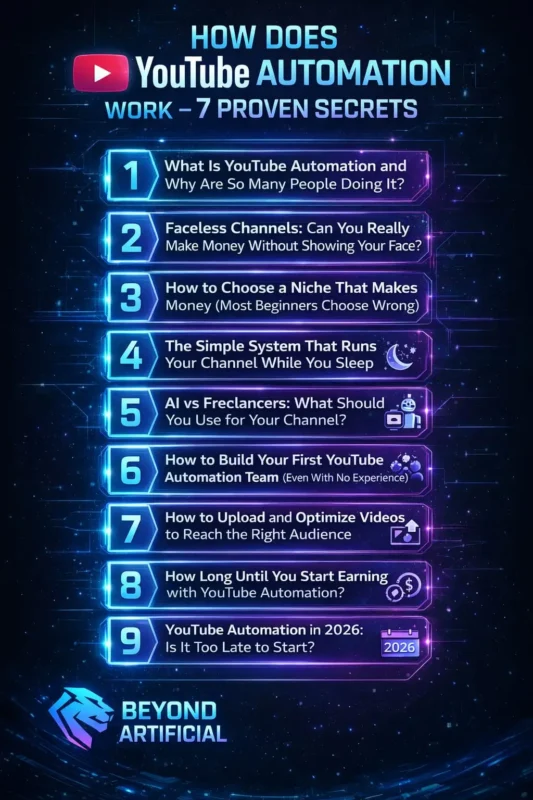
Keep reading, understand each secret carefully, and take your first step toward building your own YouTube Automation business today. Your financial freedom can start with one simple decision.
1. What Is YouTube Automation and Why Are So Many People Doing It?
YouTube Automation lets you run a money-making channel without sitting in front of a camera, writing scripts, or spending hours editing. You can use AI tools or hire a small team to handle everything, writing, voiceovers, editing, and thumbnails, while you focus on growing your income. Thousands of beginners are already doing this because it gives them time, freedom, and real money without trading their life for it. If you’re starting, pick one niche you understand.
Do not jump into too many ideas at once; it will only slow you down. Spend 3–5 days researching what content works in your niche before creating anything. Treat your channel like a real business: reinvest early earnings into better editors and writers, and watch it grow. The people who succeed in YouTube Automation are not the luckiest; they are the ones who stay consistent, keep learning, and never give up.
2. Faceless Channels: Can You Really Make Money Without Showing Your Face?
Yes, you can make real money on YouTube without showing your face, and thousands of people are doing it every day. Faceless channels share valuable content, like education, entertainment, or information, using voiceovers, stock footage, animations, or screen recordings. The focus is on the content, not the creator. The main reason people love faceless channels is freedom, staying private, avoiding camera anxiety, and still building an income that grows while they sleep.
If you are starting, pick a niche where people are actively searching for answers, like finance, health, tech, or self-improvement. A strong voiceover is key; make sure it’s clear, confident, and engaging, because bad audio can make viewers leave in seconds. Also, use eye-catching thumbnails and powerful titles, because even the best content would not grow with weak visuals.
Most importantly, stay consistent. Your face is not your biggest asset; your knowledge, value, and content are what will make people subscribe, trust, and come back again and again.
3. How to Choose a Niche That Makes Money (Most Beginners Choose Wrong)
Choosing the wrong niche is the number one reason YouTube Automation channels fail, and most beginners make this mistake before uploading their first video. A profitable niche is not just something you like; it’s a topic where people are actively searching for answers, advertisers pay well, and competition is manageable. The top money-making niches right now are finance, health, tech, self-improvement, and legal advice, because these audiences are eager, watch videos fully, and take action fast.
Always validate your niche before investing time or money. Check YouTube to see if channels in that niche are getting hundreds of thousands of views; high views mean high advertiser demand. Do not pick a niche just because you like it. Make sure advertisers are paying well using tools like Google Keyword Planner or TubeBuddy.
Pick a niche that solves real, urgent problems. When your content gives someone the answers they desperately need, they will watch, subscribe, share, and come back for more. The right niche with research and strategy can bring consistent income, while the wrong niche will waste your time, money, and energy.
4. The Simple System That Runs Your Channel While You Sleep
The best part about YouTube Automation is that once your system is set up, your channel can earn and grow while you sleep, travel, or spend time with family. This is not magic; it’s a simple workflow where every step, from scripting to publishing, is handled by AI tools or a freelance team, without you doing the work. Successful creators build the system once, refine it, and then oversee it like a business, spending just 1–4 hours per week while their channel runs on autopilot.
Start step by step: first hire or use AI for scripts, then add a voiceover artist, then a video editor. Only move to the next step when the current one works smoothly. Do not try to automate everything at once; rushing leads to poor content, and poor content can ruin your channel faster than anything else. Create a simple guide for each team role so everyone knows exactly what to do and when, without constant instructions.
The creators who earn while they sleep are no luckier; they built a solid system, trusted the process, and stayed patient until it worked beautifully.
5. AI vs Freelancers: What Should You Use for Your Channel?
One of the first big choices in YouTube Automation is whether to use AI tools or hire freelancers. Choosing wrong can waste money, slow growth, and frustrate you. AI tools are fast, cheap, and always available, perfect for beginners on a budget who want to create content quickly. Freelancers add creativity, emotion, and a human touch, great for when your channel grows, and viewers expect higher quality.
If you are starting with little or no budget, begin with AI for scripts and voiceovers, test your niche, and only hire freelancers once your channel starts earning. Always review and improve AI content, because raw AI can feel robotic, and viewers will leave. As your channel grows, use a hybrid approach: let AI handle research and drafting, and let freelancers polish and humanize your content.
The goal is not to pick one forever; it’s to use whatever combination gives your audience the most value, your channel the most growth, and your life the most freedom.
6. How to Build Your First YouTube Automation Team (Even With No Experience).
Building your first YouTube Automation team can feel scary at first, but thousands of beginners with no experience have done it, and you can too. You only need three key people to start:
1. A scriptwriter who knows your niche
2. A voiceover artist with a clear, engaging voice
3. A video editor who turns raw footage into polished videos
You do not need full-time employees or a big budget. Platforms like Fiverr, Upwork, and PeoplePerHour have talented freelancers who work per video at beginner-friendly prices. Start one role at a time. Begin with a scriptwriter, then add a voiceover artist, and finally a video editor. Test at least three freelancers for each role with a small paid sample to find the right fit. Always communicate your vision, style, and expectations clearly using briefs and reference videos. A confused team makes confused content, which can hurt your channel growth.
Remember, your team is your greatest asset. Treat them well, pay fairly, give clear feedback, and invest in their growth. A motivated team will help you build your YouTube empire faster than any tool or shortcut ever could.
7. How to Upload and Optimize Videos to Reach the Right Audience.
Making a great video is only half the battle; if you do not upload and optimize it properly, even the best content can go unseen. YouTube SEO is what pushes your videos in front of the right audience at the right time, keeping them discovered and watched long after you upload. The creators who grow successful automation channels are not always making the best videos; they know how YouTube’s algorithm works and give it the right signals every time they upload.
Always do keyword research before writing your title or description. Use tools like TubeBuddy, VidIQ, or YouTube’s search bar to find what your audience is searching for. Your title must spark curiosity, promise a benefit, and include your main keyword naturally; it decides if someone clicks or scrolls past. Fill your description with keywords, timestamps, and a clear call to action in the first few lines, because YouTube uses it to show your video to the right people.
Think of uploading without optimization like opening a shop in the middle of a desert; no matter how good your product is, nobody will find it without the right signs.
8. How Long Until You Start Earning with YouTube Automation?
Every beginner wonders: how long until I start earning with YouTube Automation? The honest answer: most channels see their first real income 6 to 12 months after consistently publishing high-quality, strategic content. The timeline depends on your niche, content quality, consistency, and video optimization. The exciting part? Once your channel reaches monetization and finds its audience, income keeps coming month after month.
Set a realistic publishing schedule from the start. Channels that upload 2–3 videos per week in the beginning reach monetization faster than those uploading randomly. Do not focus only on subscribers; watch time matters most. You need 4,000 watch hours and 1,000 subscribers, and watch time is the harder milestone. Reinvest any early earnings into better content, stronger thumbnails, and skilled freelancers; even small upgrades can speed up growth.
Remember, creators who quit early never see the payoff. Trust the system, stay consistent, improve every video, and keep moving toward the financial freedom you are building.
9. YouTube Automation in 2026: Is It Too Late to Start?
Many beginners ask: Is it too late to start YouTube Automation in 2026? The answer is a confident No, it’s absolutely not too late. YouTube is still growing fast, adding over 500 hours of new content every minute, with advertisers spending more than ever. New channels are still reaching monetization every week. Those who say “it’s too late” are the same people who said that in 2020, 2021, and 2022. The ones who started anyway are now running profitable channels that earn while they sleep.
Your biggest advantage in 2026 is AI; use it to create content faster, smarter, and cheaper than ever before. But do not enter an oversaturated sub-niche without a unique angle. Study competitors, find gaps, and deliver something fresher and more valuable. Focus on evergreen content, topics people will still search for years from now, because it keeps earning long after trendy videos fade.
Remember: the best time to start was yesterday, the second-best time is today. Every week you wait is a week someone else is uploading, building their system, and moving closer to the life you dream of.
FREQUENTLY ASKED QUESTIONS(FAQs)
How does YouTube automation pay you?
YouTube Automation pays you through multiple income streams that keep earning even when you are not working. Once your channel is monetized, AdSense deposits money, brands offer sponsorships, affiliate commissions stack up, and digital product sales add extra income. The best part? One video can keep making money for months or even years later.
How many YouTube views do I need to make $10,000 per month?
The views needed to make $10,000 a month on YouTube depend on your niche and CPM. High-CPM niches like finance or legal may need 500K–1M views, while low-CPM niches could need 5–10M. Smart creators combine AdSense with sponsorships, affiliate marketing, and digital products to reach $10K faster with fewer views.
Which content is most attractive on YouTube?
The most attractive YouTube content solves a problem, sparks curiosity, or triggers emotion. Niches like finance, health, self-improvement, tech, and true crime perform best because they tap into what people need or desire. The key is a scroll-stopping thumbnail, a curiosity-driven title, a strong hook, and valuable content that leaves viewers inspired or informed.
What are the risks of YouTube automation?
YouTube Automation is exciting but comes with real risks, like low-quality freelancers, breaking YouTube rules, choosing the wrong niche, or losing motivation. These risks can hurt your channel growth or even get your channel banned. The good news: they are avoidable by choosing your niche wisely, hiring quality team members, following YouTube’s rules, and staying consistent.
Which type of YouTube channel grows fast?
YouTube Automation is exciting but comes with real risks, like low-quality freelancers, breaking YouTube rules, choosing the wrong niche, or losing motivation. These risks can hurt your channel growth or even get your channel banned. The good news: they are avoidable by choosing your niche wisely, hiring quality team members, following YouTube’s rules, and staying consistent.
How much does YouTube automation pay?
You have probably wondered if YouTube Automation can really pay your bills, replace your 9-to-5, and give you the financial freedom you have been dreaming about. The truth is, most people never find out because they quit too early, follow the wrong advice, or never take that first step. Here is the good news: YouTube Automation can pay from a few hundred dollars to tens of thousands every month, depending on your niche, consistency, and how smartly you build your system. It’s not complicated; it starts with knowing where the money comes from, how much each income stream pays, and what steps to take right now to set your channel up for success.
Once you understand the numbers and the process, fear turns into a plan, confusion turns into clarity, and your dream turns into a decision. Here is where YouTube Automation income comes from:
AdSense Revenue: Earn money whenever someone watches ads on your videos
Sponsorships: Brands pay you to feature their products
Affiliate Marketing: Earn commissions by recommending products your audience needs
Channel Memberships: Loyal viewers pay monthly for exclusive content
Digital Products: Sell courses, eBooks, or templates directly to your audience
