
 YouTube Automation
Is YouTube Automation a Good Investment in 2026? -7 Honest Truths(Blog#:63)

Every single day, thousands of people type “Is YouTube Automation a Good Investment in 2026” into Google, and most of them are not curious; they are desperate for a real answer before they make a costly mistake. Maybe you have already spent hours watching YouTube gurus paint this dream of faceless channels, passive income, and financial freedom, and something inside you is quietly asking, But is this actually real, or am I being played?
That gut feeling you have right now? It matters because YouTube Automation in 2026 has completely changed, and the rules that made people rich just two years ago are quietly failing people today. You deserve more than recycled hype; you deserve the raw, uncomfortable truths that nobody in this space wants to say out loud, especially when your time, money, and hope are on the line.
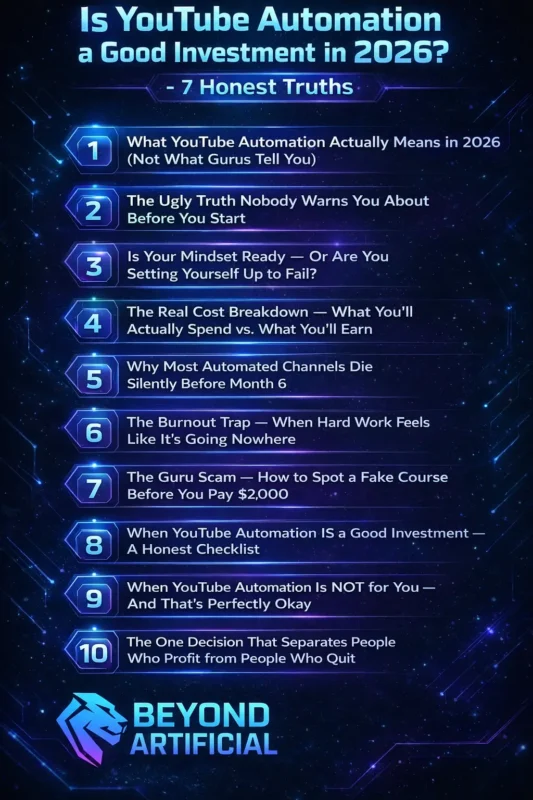
So take a deep breath, keep reading, and let these 7 honest truths finally give you the clarity you have been searching for, because the right decision starts here.
Before you invest your time and money, it is important to understand whether YouTube automation is worth it and what most people get wrong at the start.
1. What YouTube Automation Actually Means in 2026 (Not What Gurus Tell You).
Most people enter YouTube Automation thinking a robot will do everything. At the same time, they sleep and wake up rich, and it is quietly stealing your time, money, and confidence every single day. YouTube Automation in 2026 is not a machine that runs itself; it is a real digital media business where you act as the CEO, making smart decisions about strategy, content quality, and team management.
The word automation simply means you build a repeatable system, hiring writers, editors, and voice artists, so the channel runs without you doing every task personally, but your thinking, your vision, and your standards must stay fully present. Here is your first honest tip: before you spend a single dollar, ask yourself: Am I ready to lead a business, or am I just chasing easy money?, because your answer will determine everything that follows. Your second tip is this: stop measuring success by month one results, because every strong automated channel goes through a 3 to 6 month silent phase where growth feels invisible, but the foundation is being built.
The third tip that no one will tell you is that the human touch, your research depth, your storytelling angle, and your quality control are the one thing YouTube’s algorithm rewards and AI can never fully replace. So treat YouTube Automation not as your escape from hard work, but as your smarter way of doing it, and that mindset shift alone puts you miles ahead of 90% of people who start and quietly give up.
2. The Ugly Truth Nobody Warns You About Before You Start.
Nobody tells you before you start, “You might spend $3,000, give six months of your life, and still end up with a channel that has only 47 subscribers and $4 in AdSense”, and this is the hard truth about YouTube Automation that most people do not say. After 12 months, about 80 to 90 percent of new automation channels stop, get abandoned, or lose monetization, not because people are lazy, but because they were never prepared.
Most people fail not because the model does not work, but because they start with wrong expectations and weak commitment, and the gurus selling $2,000 courses already know this, yet they still take advantage of your hopes. Your first tip is simple: before spending any money, take 30 days to learn from free content and follow creators who show real results, because if someone truly had a system making $10K per month, they would grow their own channels instead of selling it.
Your second tip is to make a clear 6-month plan before uploading your first video, decide your budget, how many videos you will post, and when you will stop if things do not work, so emotions do not control your decisions later. Your third and most important tip is this: when you feel like quitting around month three or four, understand that this is normal; most channels take 6 to 12 months just to recover their costs, and this quiet phase is where most people give up right before success.
The real truth is not that YouTube Automation is a scam; it is that no one prepares you for the mental pressure of waiting, and the people who stay patient during this phase are the ones who actually win.
3. Is Your Mindset Ready, Or Are You Setting Yourself Up to Fail?
Before you buy any tool, hire a freelancer, or upload your first video, ask yourself one honest question, “Am I starting this to build something, or am I just trying to escape a job I do not like?, because automation without a clear plan only makes you fail faster, and when people automate weak ideas or random content, they just upload more mistakes quickly.
The truth is, automation is not a shortcut; it is a system you build after you understand how YouTube works, not before, and most people fail because of the wrong mindset, not the wrong strategy. Many beginners compare themselves too much; they see income screenshots, watch someone else’s results, and feel like they are already behind, but in reality, most successful channels take 12 to 24 months to become profitable, and no one shows those slow months. Your first mindset tip is simple: stop asking “How fast can I make money?” and start asking “How long can I stay consistent before I see results?” and write your answer down, because success in 2026 comes from building systems that improve over time, not chasing quick wins.
Your second tip is to stop trying to be perfect. Many beginners delay uploading because they want everything perfect, and this only stops progress instead of improving it. Your third and most important tip is this: you still need to choose the right niche, create strong titles and thumbnails, and understand audience retention and analytics, because no tool, no course, and no freelancer can replace your thinking and decisions.
So check your mindset today, not your budget, not your tools, not even your niche, because everything in this journey depends on how you think.
4. The Real Cost Breakdown, What You Will Actually Spend vs. What You Will Earn.
Let’s talk about the number no one shows. One real creator spent $30,000 on three channels and made back only $9,900 in six months, and this is not to scare you, but to help you understand the reality before you start with just $500, thinking it will change your life. A realistic starting budget for good-quality content is between $500 and $2,000 for the first two to three months, covering script writing, voiceover, editing, stock footage, and tools, and this money is spent long before you earn anything back.
Most automation channels do not recover their costs for the first six to twelve months, which means you need to be ready to keep investing money while seeing little or no results, and this slow phase is where most people lose patience and quit. Your first tip is to create a “survival budget”, keep your channel money completely separate from your personal expenses, because monthly production costs can start from $600 to $850 and increase as your channel grows, and mixing this with your rent money will only create stress and bad decisions.
Your second tip is to watch out for hidden costs, things like copyright issues, redoing videos, and tool subscriptions that can grow from $50 to $200 per month, which are common problems that many beginners do not plan for. Your third tip is to stop comparing your early results with someone else’s success, because channels making $10,000 per month usually spend 6 to 18 months building first, and they never show their struggles from the early days. The real cost of YouTube Automation is not just money; it is the patience to keep investing, keep working, and keep believing in the process even when it feels like nothing is working.
To understand the earning side clearly, you need to know how to Make Money Using YouTube Automation with AI and what actually drives revenue in 2026.
5. Why Most Automated Channels Die Silently Before Month 6.
Most automated channels do not fail suddenly; they fade away slowly, one missed upload at a time, until one day the creator realizes they have not worked on the channel for weeks, and it feels like relief instead of failure. Channels made with generic scripts, repeated ideas, stock footage, and basic AI voiceovers do not fail instantly; they struggle quietly, either not getting monetized or earning very little even when they get views.
YouTube does not need to ban them; it just stops pushing them. Most people quit after 10 to 15 videos, while successful automation channels usually upload 50 to 100 videos before seeing real growth, which means the channel you stopped at video 12 might have been very close to success. Your first tip is to treat your upload schedule like a serious job, not something you do only when you feel motivated, because automation works only when you stay consistent, and without that, you lose momentum and start getting frustrated.
Your second tip is to review your channel every 30 days like a business, check your click-through rate, watch time, and which videos perform best, because YouTube mainly looks at click-through rate, watch time, engagement speed, and returning viewers, and ignoring these can slowly kill your channel without you realizing it. Your third and most important tip is this: before spending more money or hiring people, first make sure your content actually works by testing your first few videos and seeing how viewers respond, because automating a weak strategy only makes you fail faster and waste more money.
The channels that succeed after six months are not more talented or lucky; they just stayed consistent and didn’t let slow results make them quit.
6. The Burnout Trap: When Hard Work Feels Like It is Going Nowhere.
There is a very real and painful moment in YouTube automation that no one talks about; it is not the day you quit; it is the day you keep delaying your next video for weeks, and somehow not working feels easier than continuing. Up to 90% of creators face burnout, and for automation creators, it feels even worse, because you started this to escape stress, but now the same system is making you feel tired and drained.
Burnout usually happens in stages. It starts with stress, then pressure builds, then self-doubt grows, and finally, you reach a point where you don’t feel like creating anything at all, and most people go through this quietly without telling anyone, because they feel like they failed. Your first tip to deal with burnout is simple: stop checking your analytics every day, because constantly watching views and numbers creates anxiety, and people who check less often feel much calmer, so choose one day per week to review your performance.
Your second tip is to follow a “minimum work” plan. On difficult days, just do one small task for your channel instead of trying to do everything, because slow and steady progress always beats short bursts followed by burnout, and small daily steps build strong results over time. Your third and most important tip is this: do not tie your self-worth to your channel’s performance, because many factors are outside your control, and your value as a person is not decided by your views or subscribers.
Burnout does not mean YouTube automation is not for you; it means your system needs rest, your expectations need adjustment, and you need to understand this clearly: getting through this phase is part of the journey, and the creators who rest smartly come back stronger than those who push themselves until they break.
7. The Guru Scam: How to Spot a Fake Course Before You Pay $2,000.
Look, if you have ever sat in front of your screen with your card ready, about to spend $2,000 on a course from someone showing luxury cars on Instagram, stop for a second, because you might be making a bad decision. Many fakes create big dreams and false hope, showing cars, houses, and success to make you believe their “secret method” made them rich, but in reality, they make money from selling courses to people like you.
These people promise quick results, easy success, and high income, but most of the time, their course gives you very little value and leaves you disappointed. So how do you protect yourself?. First, always check their claims, spend just 5 minutes searching their name on Google, Reddit, or LinkedIn, because if someone really made millions, there will be proof outside their own website. Second, be careful of fake urgency, countdown timers, and “today only” offers that reset again and again, which are tricks to make you buy quickly without thinking. Third, do not trust testimonials on their sales page; instead, search real reviews online, because honest reviews mention both good and bad points, while fake ones sound like ads.
Finally, always check the refund policy; real creators offer simple 30 to 60-day refunds, but scammers make it very hard by adding too many conditions.
8. When YouTube Automation IS a Good Investment, An Honest Checklist.
Look, if you have been watching YouTube videos where people claim they make thousands from faceless channels and you are thinking, “Is this real or just another trap?” that feeling is completely normal. Here is the truth: YouTube automation can work, but it is not passive, not automatic, and not a guaranteed shortcut to big money. It is a real business, and it only works for people who treat it seriously, with good content, smart niche selection, and long-term consistency.
The right time to invest is when you are building something original that helps viewers, not when you are trying to trick the algorithm with low-quality, copied content that gets ignored quickly. So before you spend any money, follow this simple checklist: start with a realistic budget (around $3,000 if you plan to outsource for a few months), keep your costs low at the beginning, and only increase spending when your channel starts showing real growth. Protecting your money is very important.
Choose a high-earning niche like finance or tech, because your niche decides how much you can earn per 1,000 views; a good niche can make a huge difference in income. Even if you outsource everything, be ready to spend 15–20 hours every week managing your team, checking scripts, reviewing edits, and tracking performance. This is not a hands-free system.
Finally, choose a niche you actually care about, because automation can help with work, but it cannot replace your ideas, and when you lose interest, your channel will slowly stop growing, no matter how good your tools are.
9. When YouTube Automation Is NOT for You, And That’s Perfectly Okay.
Honestly, if YouTube automation is not working for you, if you feel frustrated, tired, and like you are wasting money, understand this clearly: you are not a failure, and choosing to stop or change direction can be a very smart decision. YouTube automation does not work for quick money or instant passive income, because the first six months usually need your time, money, and patience, even when results are slow or disappointing.
Many people think “automation” means everything runs by itself and money comes easily while you sleep, but that is not true, and believing this is what causes most people to fail. So here is how to know honestly if this is not right for you right now: if you do not have at least $1,000–$3,000 to invest without stressing about your bills, it is better to stop and focus on your finances first, because low-budget channels usually do not survive.
If your niche needs real human emotion and storytelling, like true crime or personal growth, then fully automated content can feel fake to viewers, and people can easily notice that. Also, if you want to run your channel completely on autopilot without checking or improving it, that is another problem, because YouTube rewards creators who stay involved and active.
And if you simply do not enjoy managing freelancers, checking scripts, or analyzing performance, that is completely fine; not every business is for everyone. In that case, it is better to focus on something you actually enjoy, because when you force yourself to do something you do not like, the content becomes weak and people lose interest.
If you’re ready to move forward, here’s a step-by-step guide on how to start a YouTube automation business the right way.
10. The One Decision That Separates People Who Profit from People Who Quit.
If you have ever sat at your desk late at night, looking at your channel with only 47 subscribers after months of effort, and felt that heavy thought, “maybe I should just quit,” I want you to understand that this moment is very important. This is the point where people either keep going and succeed later or give up and never reach their goal. Success is not just about talent, money, or connections; it is about not quitting, even when things feel slow or difficult.
The hard truth is that the feeling of quitting often comes right before progress starts, and the discomfort you feel is not a sign to stop; it is a sign that you are growing. So here is what you should do: set realistic timelines of 6 to 12 months instead of expecting results in a few weeks, because consistency matters more than talent, and the people who keep showing up regularly are the ones who win.
When you feel like quitting, do not make that decision immediately; take a break, sleep on it, because most of the time that feeling goes away, and you think more clearly the next day. The only time quitting makes sense is when your idea is clearly not working at all and is wasting your time and money. Smart people do not quit because things are hard; they quit when something is truly broken.
In the end, the most important skill is knowing when to keep going and when to stop. Once you learn this, you will not waste your time on the wrong path again.
Like any investment, success depends on execution. Our YouTube automation services help turn it into a scalable income stream.
FREQUENTLY ASKED QUESTIONS (FAQs)
Is YouTube automation still worth it in 2026?
Yes, but the old, lazy version of YouTube automation is dying. Low-effort, copy-paste content no longer works because YouTube does not promote it anymore. In 2026, smart automation still works, but only if done right. It is now a real business that uses data, consistency, and quality, not shortcuts or “get-rich-quick” methods.
Can you invest in YouTube automation?
Yes, YouTube automation is still profitable in 2026, but only if done seriously. The old method of copying low-quality content is dead, and it will only waste your time and money. You can start small and grow, but it takes consistency. You can begin with around $100 per video, but real results come after 12–35 videos and 6–12 months of consistent effort with quality content.
What is the 30-second rule on YouTube?
The 30-second rule means keeping viewers watching past the first 30 seconds. If people stay, YouTube sees your video as valuable and pushes it to more viewers. If they leave early, your video stops growing. Focus on a strong start. Hook viewers in the first 5–10 seconds, skip long intros, and give value immediately, because the beginning decides your views, reach, and earnings.
What are the disadvantages of YouTube automation?
YouTube automation has real downsides you should know. Your channel can get banned if you use bots, your content can become repetitive, and you may lose connection with your audience. It also takes time and smart control. Monetization can take 4–6 months or more, and beginners often waste money by outsourcing too early. Always stay involved; you can outsource work, but not your ideas and strategy.
What is the most-searched content on YouTube?
The most searched content on YouTube is music, gaming, tutorials, entertainment (pranks/challenges), and relaxing videos like ASMR. These topics dominate because people come to YouTube to be entertained, learn something quickly, or relax, so creating content in these areas gives you the highest chance of getting views and growth.
Is YouTube automation a good investment in 2026 in the USA?
You have probably seen it many times: someone on Instagram or YouTube showing their online income, sitting by a pool, saying they made $10,000 last month from a faceless YouTube channel they barely worked on, and you are thinking, “Is this real, or am I being fooled again?” YouTube automation once looked like an easy shortcut, passive income, outsourced videos, no face needed
But in 2026, things have changed. YouTube rules are stricter, AI tools are everywhere, and competition is much higher. The old low-effort method, copying content and uploading, no longer works, not because YouTube banned it, but because it stopped promoting it. But here is the good news: Smart automation in 2026 is actually more powerful because it uses data instead of guessing and helps you build a stable, long-term system.
YouTube automation can still make money, but now it works like a real business that needs planning, money, consistency, patience, and the ability to adapt. Here is what this simple, honest guide will help you understand:
- Make a confident decision: whether YouTube automation is right for you or not
- Avoid wasting money: by understanding real costs and hidden risks
- Choose the right niche: one that actually makes money, not just hype
- Evaluate your situation clearly: based on your budget, time, and goals
- Set realistic income expectations: without falling for fake promises
If you are ready to play the long-term game, this can truly change your life.
