
 YouTube Automation
YouTube Shorts Algorithm Changes in 2026 –9 Powerful Secrets(Blog#:51)

You post a YouTube Short, watch the views explode, and then wonder why the next video barely reaches anyone. That confusing moment is exactly why understanding YouTube Shorts Algorithm Changes in 2026 matters more than ever. Many creators feel frustrated because the YouTube Shorts Algorithm in 2026 Secrets quietly changed how the platform decides which videos go viral and which ones disappear in the feed.
If you truly understand the YouTube Shorts Algorithm in 2026, you can finally stop guessing and start creating Shorts that the algorithm actually pushes to millions of viewers. Instead of chasing random views, you will learn how the system now rewards retention, engagement, and viewer behavior in ways most creators completely miss.
Read carefully, because these simple but powerful secrets can turn your Shorts from ignored uploads into videos the algorithm loves to promote. Before you start optimizing your Shorts for the algorithm, it is also important to understand how YouTube Shorts monetization works, because growth only becomes powerful when it turns into real revenue.
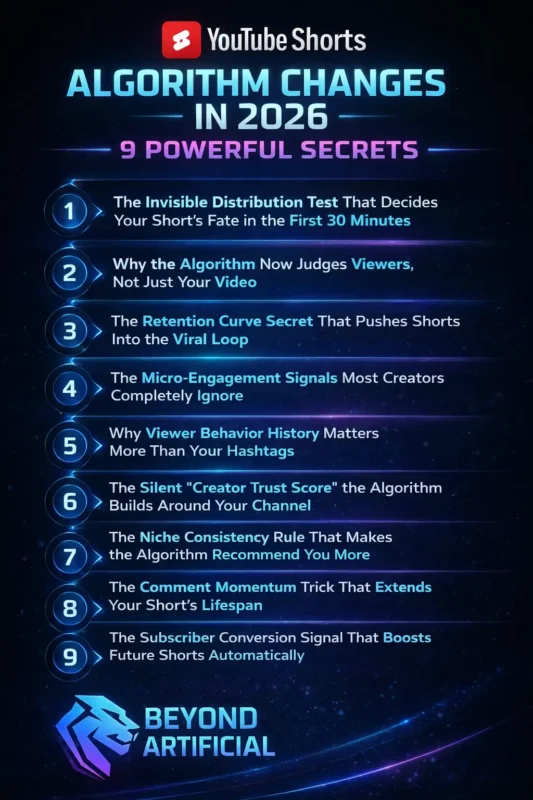
Keep reading to discover the powerful secrets behind the YouTube Shorts algorithm in 2026, and finally understand why some Shorts explode with views while others disappear without a trace.
1. The Invisible Distribution Test That Decides Your Short’s Fate in the First 30 Minutes
You upload a Short with excitement, but the truth is that the algorithm quietly runs a small test right after publishing to decide if your video deserves a bigger audience or should stop spreading. During the first stage, YouTube watches how real viewers react to your Short, whether they keep watching, swipe away, replay it, or interact with it. Many creators feel confused when their Short suddenly stops growing, but it usually means the video did not pass this early performance check.
The first tip is simple but powerful: hook the viewer immediately by showing the most interesting moment at the start, so people stay instead of scrolling. Your second tip is to keep the video tight and engaging so viewers watch until the end or replay it, because strong retention tells the algorithm your content is worth pushing further. Another helpful strategy is to encourage quick engagement, ask a simple question, or create curiosity so viewers like, comment, or share naturally. When you focus on holding attention and creating small moments that make people stay or watch again.
You give your Short a much better chance to move beyond the initial test and reach thousands of new viewers.
2. Why the Algorithm Now Judges Viewers, Not Just Your Video.
In 2026, the way the YouTube algorithm works has changed a lot. Before, YouTube mostly judged a video based on things like watch time, titles, or hashtags. But now the algorithm focuses more on how real viewers feel when they see your Short. If someone scrolls past your video in the first few seconds, the algorithm sees that as a negative signal and may stop showing your video to more people. That is why the “viewed vs swiped away” ratio has become very important for Shorts.
If most viewers swipe away quickly, your video may not get a chance to grow. One powerful tip is to make your first frame very strong. Instead of starting with a normal intro, show the most interesting or surprising moment right at the beginning, so people want to keep watching. Another important strategy is to create a satisfying ending for your Short.
Sometimes, YouTube sends surveys to viewers after they watch a video, and if viewers feel the video was valuable or entertaining, that helps the algorithm recommend it more. It is also helpful to post different types of Shorts, not just the same style every time. When your content has variety, YouTube can test it with different audiences and help your channel grow faster. I
n simple words, the biggest change in 2026 is this: the algorithm now trusts the viewer more than anything else. If viewers enjoy your content, the algorithm will push it further. YouTube engineers often explain how recommendation signals work through the YouTube Creator Insider channel, where they reveal how viewer satisfaction influences distribution.
3. The Retention Curve Secret That Pushes Shorts Into the Viral Loop.
Most creators focus on views, subscribers, and how often they post. But in 2026, the smartest creators focus on one thing inside YouTube Studio: the retention graph. This graph shows how long people keep watching your Short. If the line suddenly drops, it means viewers are leaving, and the algorithm may stop promoting your video. That is why two creators can upload the same idea but get very different results.
The YouTube algorithm now studies the shape of your retention curve. If viewers keep watching until the end, your video can reach millions of views. But if people leave early, the video may stop growing. YouTube can also tell the difference between a real rewatch and a fake loop. Old tricks like cutting the video suddenly to force a replay no longer work and may even hurt your channel. One important tip is to build your Short in clear stages.
Try to keep most viewers during the first few seconds, keep the middle interesting by changing visuals or ideas every few seconds, and end the video in a way that makes people want to watch again. Another important tip is to remove every unnecessary second. Slow intros, pauses, or filler lines are usually the moments where viewers leave. Before posting your Short, watch the last three seconds and the first three seconds together. If they connect naturally, viewers may replay the video without noticing. This kind of natural loop is a strong signal to the algorithm that people enjoyed your content.
When you start using the retention graph as a guide instead of just a report, you can design every Short in a smarter way and increase your chances of going viral.
4. The Micro-Engagement Signals Most Creators Completely Ignore
Many creators focus only on likes, views, and subscriber numbers. But the YouTube algorithm in 2026 is actually paying attention to small viewer actions that most creators never notice. These tiny behaviors help decide whether your Short is shown to a few hundred people or millions. The algorithm watches things like whether viewers watch another video from your channel, tap “Not Interested,” or rate your video positively in satisfaction surveys. These small signals can be more important than hundreds of simple likes from viewers who were not very engaged.
Actions like shares, saves, and remixes are even stronger signals because they show that someone thought your content was valuable enough to pass to others. One helpful tip is to create a reason for people to share your Short. You can end your video with a surprising fact, a relatable message, or a moment that makes people want to send it to a friend. When viewers share your content, the algorithm sees it as strong proof that your video is valuable.
Another important tip is to avoid misleading titles or thumbnails. If viewers feel tricked, they may tap “Not Interested,” which sends a strong negative signal to the algorithm. Finally, try to include a moment that makes viewers want to watch the Short again, such as a surprising twist or a hidden detail.
When you start paying attention to these small viewer actions, you can design Shorts that encourage positive signals, and that can help your videos reach a much larger audience.
5. Why Viewer Behavior History Matters More Than Your Hashtags.
Most creators believe that hashtags are the secret to getting views, but the real truth is that the YouTube algorithm cares far more about viewer behavior history than any hashtag you add to your description. YouTube’s system studies what each person has watched before, what they skip, and what they rewatch, and then recommends videos based on those patterns, meaning your Short is pushed to people whose past behavior suggests they might enjoy it.
If the audience that first sees your video watches it fully or interacts with it, the algorithm quickly finds more viewers with similar behavior and expands your reach. So instead of stressing over hashtags, your first tip is to create content for a very clear audience interest, because the algorithm learns from viewers’ watch history and matches your video with people who already enjoy similar content.
Your second tip is to study your analytics and repeat topics that keep viewers watching longer, since strong retention and engagement tell the system your video deserves more recommendations. Another powerful tip is to design hooks and stories that make viewers stay until the end or watch another video from your channel, because that behavior signals satisfaction to the recommendation system. Once you understand that YouTube grows videos based on viewer behavior patterns rather than metadata tricks, you stop chasing hashtags and start creating content that truly connects with the right audience, and that is when growth finally starts to feel possible.
Understanding how the YouTube recommendation system works helps creators see why viewer behavior matters more than hashtags.
6. The Silent “Creator Trust Score” the Algorithm Builds Around Your Channel.
Most creators think the algorithm only judges each video separately, but in reality, YouTube quietly builds a long-term trust profile around your entire channel based on how your content performs over time. This invisible “creator trust score” grows when your videos consistently keep viewers watching, satisfy them, and bring them back to your channel again and again.
Channels that repeatedly deliver strong retention, engagement, and consistent topics earn higher authority, which makes the algorithm more confident in recommending their future uploads. If you feel like your videos sometimes get buried even when the idea is good, your first tip is to focus on consistent quality and topic clarity, because channels that stay reliable in what they upload slowly build algorithmic trust. Your second tip is to avoid rushing uploads just to stay active. One strong video that keeps viewers watching builds far more trust than five weak videos that people abandon early.
Another powerful tip is to design videos that lead viewers to watch another video from your channel, because longer viewing sessions signal to the algorithm that your content is valuable and worth recommending more often. When you understand that the algorithm is quietly judging your channel history, not just your latest upload, you stop chasing quick tricks and start building a channel the system learns to trust, and that is when real, sustainable growth finally begins.
7. The Niche Consistency Rule That Makes the Algorithm Recommend You More.
Here is the simple truth many creators miss: two channels with the same subscribers, posting schedule, and video quality can get completely different results from the algorithm. The reason is often niche consistency. If one creator sticks to a clear topic while another keeps changing topics, YouTube finds it much easier to understand the first channel’s audience. When the algorithm clearly knows who your viewers are, it can confidently recommend your Shorts to people who already like similar content.
But when a channel jumps between unrelated topics, the algorithm becomes confused about the audience. If the system cannot identify who should watch your videos, it becomes cautious and shows your content to fewer new viewers. This is why many successful Shorts channels grow faster after posting many videos within one clear niche. Over time, the algorithm collects enough viewer data to understand exactly who enjoys your content.
A helpful tip is to define your niche in one simple sentence before posting your next Short. For example, instead of saying “fitness content,” you could say “30-second workouts for busy moms over 40.” Another strong strategy is to create a repeatable content series so viewers recognize your videos and want to watch multiple episodes. You can also follow the 90/10 rule: spend about 90% of your content strengthening your niche and only 10% experimenting with trends.
When you treat niche consistency as a strategy instead of a limitation, the algorithm can finally understand your channel, and that is when your content starts reaching the right viewers again and again.
8. The Comment Momentum Trick That Extends Your Short’s Lifespan
Many creators feel frustrated when their Shorts get views for a few hours and then suddenly stop growing, but what most people miss is that comment momentum can quietly extend a Short’s lifespan in the algorithm. YouTube does not just count comments; it watches how conversations keep happening under your video because active discussions signal that viewers are emotionally invested.
When people keep commenting, replying, and returning to read responses, the algorithm sees your Short as content that still matters and continues testing it with new audiences. One powerful tip is to ask a simple question at the end of your Short, like “What would you do in this situation?” or “Which one would you choose?” because questions naturally invite viewers to comment. Another smart tip is to reply to early comments quickly, since the creator’s replies restart the conversation and encourage more viewers to join the discussion.
You can also pin a comment that sparks debate or curiosity, because pinned comments often become the center of the conversation and keep the comment section active. When you start treating comments as the heartbeat of your Short instead of just feedback, your videos stop dying after a few hours and start living longer in the feed, and that small shift can completely change how your channel grows.
9. The Subscriber Conversion Signal That Boosts Future Shorts Automatically.
Many creators think subscribers only matter for vanity numbers, but the truth is that when viewers subscribe after watching your Short, the algorithm reads it as a strong satisfaction signal. This “subscriber conversion signal” tells YouTube that your content impressed someone enough to follow your channel, which increases the chances that your future videos will be recommended to similar viewers.
Even though subscriber count itself does not directly rank videos, engagement actions like subscribing show the algorithm that your content builds a loyal audience and deserves more exposure. If your Shorts get views but not subscribers, your first tip is to give viewers a clear reason to subscribe, such as promising a specific type of content they will keep getting from your channel. Your second tip is to place a natural call-to-action near the end, like “Follow for daily tips like this,” because clear CTAs can significantly increase subscriber conversions from Shorts.
Your third tip is to create recognizable series or recurring topics, since viewers are more likely to subscribe when they expect more valuable content coming next. When a viewer subscribes after watching your Short, the algorithm learns that your video satisfied that viewer and may recommend your future uploads to similar audiences. Once you start designing Shorts that turn casual viewers into loyal subscribers, every new video you post gets a hidden boost from the trust you already built.
FREQUENTLY ASKED QUESTIONS (FAQs)
What is the 2026 algorithm for YouTube?
The 2026 YouTube algorithm now focuses more on viewer satisfaction than just watch time. Instead of only tracking how long people watch, it looks at signals like swipe-through rate, shares, replays, and how viewers react after watching your Short. The best strategy today is simple: create Shorts that leave viewers feeling satisfied at the end, because happy viewers send the strongest signal to the algorithm to recommend your content.
How long can YouTube Shorts be in 2026?
As of 2026, YouTube Shorts can be up to 3 minutes long, instead of the old 60-second limit. However, most Shorts perform best when they stay between about 20 and 45 seconds, because viewers are more likely to watch the whole video. The key rule is simple: make your Short only as long as it needs to deliver value, cut unnecessary parts, and use your retention data to find the best length for your audience.
What are the changes in YouTube in 2026?
In 2026, YouTube introduced major changes like AI-powered creation tools, longer Shorts, better live streaming, in-app shopping, and smarter monetization features. The platform is also cracking down on low-quality AI content while rewarding creators who produce original and valuable videos. With over 200 billion daily Shorts views, creators who adapt to these new updates can grow much faster, while those using old strategies may struggle to reach new audiences.
What makes a short go viral?
In 2026, YouTube’s AI now analyzes Shorts more deeply and focuses on how satisfied viewers feel, not just clicks or watch time. Shares have become one of the strongest viral signals because when someone shares your Short, it tells the algorithm the content is truly valuable. To increase your chances of going viral, start your Short with an exciting moment, trigger strong emotions like curiosity or surprise, and end it in a way that naturally encourages viewers to watch again.
Which type of Shorts are most viewed on YouTube?
Entertainment Shorts get the most total views on YouTube, but Food & Drink Shorts often receive the highest average views per video. Other popular categories include comedy, DIY, gaming, and sports, which regularly attract large audiences. The best strategy is to choose a niche you enjoy that also has strong demand and good advertiser value—like finance, tech, or business, so your Shorts can gain views and earn better revenue.
How does the YouTube Shorts algorithm work?
Many creators feel frustrated after posting Short after Short with real effort and creativity, only to watch another simple clip go viral while their videos get ignored. The truth is, this often happens because the YouTube algorithm has changed, and most creators still do not understand how it really decides which Shorts to push. In 2026, the system is no longer focused only on how long people watch, but more on how satisfied viewers feel after watching your Short. When viewers feel entertained, curious, or happy with the video, the algorithm sees that as a strong positive signal.
There are three main things the algorithm now watches very closely. The first is viewer behavior signals, such as whether people watch the video fully, swipe away, tap “Not Interested,” or even interact with it. The second is what happens in the first few seconds, because if viewers quickly swipe away, the algorithm assumes the video is not interesting and stops pushing it further. The third factor is search relevance, since titles and descriptions now help Shorts appear in search results just like longer YouTube videos.
When these three factors start working in your favor, the same effort you are already putting into your Shorts can finally start bringing better reach, more viewers, and real channel growth.