
 YouTube Automation
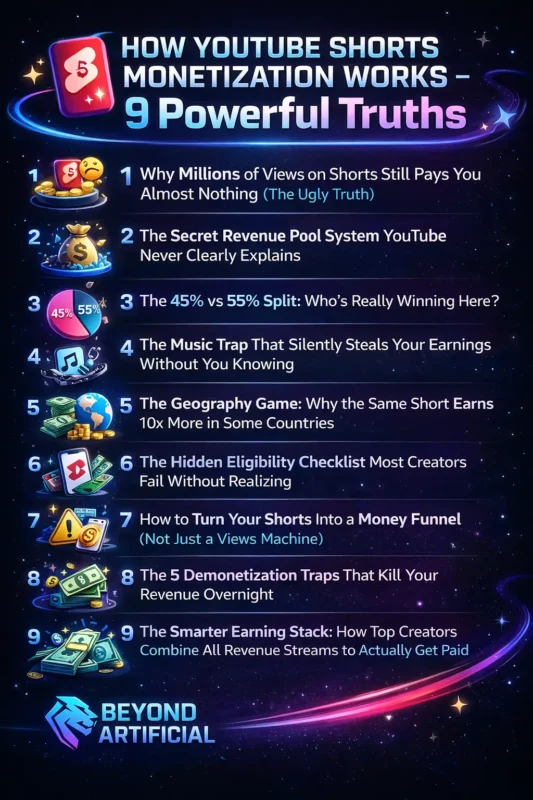
How YouTube Shorts Monetization Works – 9 Powerful Truths(Blog#:50)

Many creators post hundreds of YouTube Shorts, get millions of views, but still earn very little money. The main reason is simple: they do not understand how YouTube Shorts monetization works. Maybe you have also looked at your analytics and wondered why a viral Short with thousands or even millions of views only earned a few dollars.
The truth is, nothing is wrong with you. Most creators just do not know the system behind Shorts’ earnings. YouTube uses a shared revenue pool system, where creators receive about 45% of the allocated revenue. Because of this, Shorts usually pay less than long-form videos. But once you understand how YouTube Shorts monetization really works, everything changes. The music you choose, the type of content you make, and how consistently you post can all affect how much you earn.
These 9 powerful truths will help you understand the system better and create Shorts that grow your channel and increase your earnings.
If you want to scale your shorts faster, you should learn how to automate short-form videos using AI tools.
Keep reading to discover the powerful truths behind YouTube Shorts monetization.
1. Why Millions of Views on Shorts Still Pays You Almost Nothing (The Ugly Truth).
You stayed up late, posted your best Short, watched it reach a million views, and then YouTube paid you only $32. That moment can feel very frustrating. The reality is that Shorts usually pay only $0.05 to $0.15 per 1,000 views, which is much lower than long-form videos because ads are not attached directly to each Short. Instead, all Shorts ad revenue goes into a shared monthly pool, and creators receive only a small share based on their percentage of total global views.
Here is an important tip: stop chasing only views and start focusing on the right audience. Views from countries like the US, UK, and Canada usually generate more revenue, so creating English content and posting when Western audiences are active can help increase earnings. Another thing many creators do not realize is that using copyrighted music can reduce your earnings, because the revenue must be shared with music rights holders. That is why using YouTube’s free original audio is often a smarter choice.
Your second big strategy is to use Shorts as a funnel, not the final goal. Many successful creators use Shorts to bring viewers to long-form videos, courses, or affiliate products, where the real income usually comes from. Once you stop measuring success only by views and start thinking about strategy, the numbers will finally begin to make sense.
2. The Secret Revenue Pool System YouTube Never Clearly Explains.
Imagine a big piggy bank at YouTube headquarters. Every month, advertisers put money into it from ads shown between Shorts. Then YouTube divides that money among millions of creators around the world. This means your Short is not earning money on its own; it is competing for a small share of a big pool. Even if a viewer does not see an ad right before your Short, your views can still count if they saw an ad during their scrolling session.
But here is the part most creators do not realize: only engaged views matter, not just total views. YouTube distributes money from the Creator Pool based on each creator’s share of eligible engaged views in each country. If someone scrolls past your Short quickly without watching it properly, that view usually does not help your earnings. Your first powerful tip is to focus on watch-through rate instead of just view count. Hook viewers in the first second, build curiosity in the middle, and end the video in a way that makes people replay it.
Replays count as engaged views and can increase your share of the pool. Another important thing is music usage. Shorts without music send 100% of the related revenue into the Creator Pool, but if you use one music track, the pool share drops to about 50%, and two tracks can reduce it even more. That is why using YouTube’s royalty-free audio is often the safer choice. Your third tip is to treat the system like a daily competition, not passive income. The more consistently you post Shorts with high retention, the bigger your share of global engaged views becomes, and a bigger share means higher earnings.
Once you understand that YouTube Shorts monetization works as a share-of-the-pie system, not a simple payment per view, the numbers will finally start to make sense and you can start growing your slice of the pie.
3. The 45% vs 55% Split: Who’s Really Winning Here?
Here is a number that might surprise you. For every $100 advertisers pay YouTube for Shorts ads, creators receive about $45, while YouTube keeps the other $55. The surprising part is that this split is actually worse than long-form videos. On regular YouTube videos, creators usually keep 55% of the ad revenue, while YouTube takes 45%. But with Shorts, the system is different because of music licensing costs, which means the trending audio you use can reduce the money available for creators.
To understand the difference, many creators report earning only $30 to $200 per million Shorts views, while long-form videos can earn around $2,000 to $10,000 per million views. Your first powerful tip is to avoid copyrighted music when possible. Shorts without copyrighted music often have a higher RPM because no licensing fees reduces the creator pool. Using YouTube’s royalty-free audio or your own voice can help protect your earnings. Your second tip is to build multiple income streams instead of relying only on Shorts ads. Channel memberships can pay around 70% to creators, brand deals can pay 100%, and affiliate links also give you full control over your income.
This is why many successful creators treat Shorts as a discovery tool, not their main source of income. Shorts help bring new viewers to your long-form videos, email lists, or digital products, where the earning potential is much higher. Once you understand the 45/55 split, you stop feeling frustrated and start building smarter strategies that help you earn more from the platform.
To start earning from ads, creators must meet the YouTube Partner Program requirements.
4. The Music Trap That Silently Steals Your Earnings Without You Knowing.
You spent hours making the perfect Short, chose a trending song, and uploaded it feeling confident. But the problem is that the money from that video may not go to you at all. Instead, a large part of the revenue can go to the music rights holders. When your Short uses licensed music, YouTube shares the revenue between the Creator Pool and the music owners before creators receive their share. This means the same song that helps your video go viral can also reduce your earnings.
In fact, Shorts that use original audio often earn 20–40% more per view than Shorts using licensed music. Many new creators do not know this and upload hundreds of videos with trending songs while earning very little money. Another hidden issue is that some music tracks are geo-blocked. This means your Short may lose monetization in certain countries. If your video cannot earn in countries like the US, UK, or Canada, which usually pay the most, your revenue can drop significantly.
Your first powerful tip is to follow the 80/20 rule. Use original voice-overs, your own sounds, or YouTube’s royalty-free Audio Library in about 80% of your Shorts to protect your earnings. Only use trending copyrighted audio for the remaining 20% when you want to ride a viral trend. Many people believe that using music for less than 30 seconds avoids copyright issues, but that is a myth. YouTube does not have a time-based exception, so even short clips of copyrighted music can still affect your revenue.
Your third tip is to review your existing Shorts. Go into YouTube Studio, check which videos have music claims, and replace the audio with royalty-free alternatives when possible. This simple step can help you recover earnings that music claims may have been reducing.
5. The Geography Game: Why the Same Short Earns 10x More in Some Countries
Here is a number that can change how you think about every Short you post. In the United States, the CPM can be around $11.95, while in Pakistan it may be only about $0.42. This means two creators with the same 1 million views can earn very different amounts depending on where their audience lives. In fact, about 75% of YouTube Shorts views often come from outside a creator’s own country. So your audience location already affects your earnings, whether you plan for it or not.
In high-paying countries like the US, 10 million Shorts views can earn around $500 to $1,500. But the same number of views from lower-RPM countries may bring only $100 to $400. That is a big difference, even though the views are the same. Your first powerful tip is to target Tier-1 audiences. Create Shorts in English, talk about topics that interest viewers in countries like the US, UK, and Australia, add English subtitles, and post when American viewers are most active.
Your second tip is to choose a high-value niche. Topics like finance or technology usually earn higher RPM than entertainment or lifestyle content. For example, a finance Short with 100,000 US views can sometimes earn more than an entertainment Short with millions of views from lower-paying regions. Your third tip is to use the seasonal advertising calendar. Advertisers usually spend more money between October and December during the holiday season. Posting your best Shorts during this period can help you earn more from the same content.
Once you understand how audience location affects earnings, you can plan your content more strategically and turn the same creative effort into better income.
6. The Hidden Eligibility Checklist Most Creators Fail Without Realizing.
Many creators work for months, reach 1,000 subscribers, celebrate, apply for the YouTube Partner Program (YPP), and get accepted. But after that, they still earn nothing from Shorts. The reason is often simple: they never turned on an important setting inside YouTube Studio. Even after approval, creators must manually accept the Shorts Monetization Module in YouTube Studio before they can start earning from Shorts ads. YouTube does not always remind creators to do this, so some people stay in the program for months without earning anything.
Another thing many creators do not realize is that YouTube has two YPP levels. The first level starts at 500 subscribers and mainly allows features like fan funding. The full monetization level starts at 1,000 subscribers, which unlocks ad revenue. Some creators celebrate the first level and think they are fully monetized when they are not yet earning from ads. Your first powerful tip is to check your eligibility requirements carefully. Your channel should have no active Community Guidelines strikes, two-step verification enabled, an active AdSense account, and content that follows advertiser-friendly guidelines.
Your second tip is to keep posting regularly after monetization. If a channel stays inactive for 30 to 90 days, YouTube may review or limit monetization features. Your third tip is to avoid reused content, spam signals, or fake views. Even if your numbers meet the requirements, YouTube may still reject your application if the content is not original or if the traffic looks artificial.
When you treat YPP eligibility as an ongoing responsibility, not just a one-time milestone, you can avoid common mistakes and increase your chances of actually earning money from your channel.
7. How to Turn Your Shorts Into a Money Funnel (Not Just a Views Machine)
Here is an important mindset change every Shorts creator should understand: your Short is not the final product; it is the doorway. Many creators treat Shorts as the end goal, but that means they miss most of their real earning potential. Some creators have grown huge audiences by using Shorts as a funnel. For example, one creator gained hundreds of thousands of subscribers by using Shorts to bring viewers to longer, more detailed videos. Those long-form videos often earn much more money per view than Shorts.
In another case, a Short with 1.5 million views earned only about $10 from ad revenue, but the same video generated over $1,200 from affiliate sales. This shows that the real money often comes from what viewers do after watching the Short. Your first powerful tip is to use a simple 3-step funnel. Create a Short that introduces a problem, builds curiosity in the middle, and ends with a clear call-to-action that sends viewers to your long-form video, course, or affiliate link.Your second tip is to always give your Shorts a destination. A Short that leads to a course, ebook, or other product can earn far more than the ad revenue from the Short itself.
Your third tip is to use your description and comments wisely. Place your most important link in the description, add another link in the comments, and guide viewers to your long-form content where the earning potential is much higher. Once you start thinking of Shorts as a tool to bring viewers into your bigger content system, you can create much more income than relying on Shorts ad revenue alone.
8. The 5 Demonetization Traps That Kill Your Revenue Overnight.
Imagine waking up one morning, opening YouTube Studio, and seeing that the green dollar signs on your Shorts have suddenly turned yellow. There is no email, no clear warning: just a signal that your monetization is limited. Many creators experience this without understanding what caused it. The most common demonetization reasons include copyrighted music, advertiser-unfriendly language, reused content, COPPA issues related to children’s content, and long periods of inactivity.
Sometimes creators fall into these problems even when they believe they are following the rules. In July 2025, YouTube introduced stricter policies that removed monetization from many channels using low-effort or repetitive AI content. Channels that relied heavily on automated voiceovers, stock footage compilations, or repeated templates were especially affected. Your first powerful tip is to treat the yellow dollar sign as an early warning, not the end of monetization. It usually means limited ads, not zero ads. You can request a review, fix the issue, and potentially restore full monetization.
Your second tip is to keep your titles and thumbnails advertiser-friendly. Even a single inappropriate word in a title or thumbnail can trigger demonetization, because YouTube’s system scans those elements first. Your third tip is to stay active on your channel. If a channel stays inactive for several months, it may lose access to the YouTube Partner Program and require a new application.
Once you understand these common risks, you can avoid them and protect the monetization you worked hard to build.
9. The Smarter Earning Stack: How Top Creators Combine All Revenue Streams to Actually Get Paid.
One of the biggest mistakes Shorts creators make is believing that ad revenue is their main income. If you rely only on ad revenue, your earnings depend completely on YouTube’s system and algorithm. Successful creators understand that most of their income actually comes from other sources outside Shorts ads. Creators who earn the most usually build multiple income streams. These can include channel memberships, sponsorships, affiliate links, and digital products. This way, they can still earn money even if one video does not perform well.
YouTube already offers several tools to help creators earn more. Channel memberships, YouTube Shopping, and Super Thanks allow viewers to support creators directly. Many creators never activate these features, even though they are available in YouTube Studio. Your first powerful tip is to build your income streams step by step. Start with ad revenue, then add affiliate links, launch channel memberships when you reach 1,000 subscribers, and later introduce a course, ebook, or other digital product once your audience trusts you.
Your second tip is to share your Shorts on multiple platforms. Posting the same Short on TikTok, Instagram Reels, and Facebook Reels can help you reach new audiences and earn money from different platforms at the same time. Your third tip is to create a community membership or Patreon page. Even a small membership, such as $5 per month, can generate a steady income if enough loyal viewers join.
Once you stop thinking like a creator who only chases views and start building multiple income streams, your Shorts can become a powerful tool for growing both your audience and your income. The official YouTube Shorts guide also recommends using Shorts as a discovery tool to grow your audience.
FREQUENTLY ASKED QUESTIONS (FAQs)
How much do YouTube Shorts pay for 1,000 views?
YouTube Shorts usually pay about $0.01 to $0.10 for every 1,000 views, which is much lower than long-form videos. Most creators solve this by using Shorts to gain subscribers and drive viewers to long-form videos, affiliates, or products, where the real money is made. So the smart strategy is simple: use Shorts for reach, and use other content or offers for real income.
How many Shorts should I post daily on YouTube?
Most experts recommend posting 1–3 YouTube Shorts per day to grow faster without overwhelming the algorithm or your audience. The smart solution is to focus on consistent, high-quality Shorts instead of posting too many, because strong engagement helps the algorithm push your videos further. A simple strategy is to start with 1 Short daily, then test 2–3 per day and track which schedule brings the most views and subscribers.
Can I get 4000 watch hours on YouTube Shorts?
No, watch time from YouTube Shorts does NOT count toward the 4,000 watch-hour requirement for monetization. To solve this, creators usually upload long-form videos or live streams, because only those watch hours count toward the 4,000-hour goal. Another option is the Shorts path: reach 1,000 subscribers and 10 million Shorts views in 90 days to qualify for monetization without the 4,000 hours.
How much YouTube Shorts pays for 1,000 views.
YouTube Shorts usually pay around $0.01 to $0.10 for every 1,000 views, which surprises many creators expecting higher earnings. To increase income, focus on high-RPM audiences (US, UK, Canada) and strong viewer retention, because these factors raise your share of the Shorts revenue pool. The smartest strategy is to use Shorts to grow subscribers and send viewers to long-form videos, affiliates, or products, where the real money is made.
YouTube Shorts watch time counts for monetization.
No: watch time from YouTube Shorts does NOT count toward the 4,000 watch-hour requirement for YouTube monetization. To solve this, upload long-form videos or livestreams, because only those watch hours help you reach the 4,000-hour threshold. Or follow the Shorts path: reach 1,000 subscribers and 10 million Shorts views in 90 days to qualify for monetization.
How YouTube Shorts monetization works 2026 free
The single most dangerous belief in the Shorts creator world is thinking that ad revenue is your real income. When you believe this, you depend completely on YouTube’s system, even though the real money often exists outside the 45% ad revenue share. Creators who succeed financially usually build a stack of income streams instead of relying only on ads. They combine different sources of income so they can still earn even if one source does not perform well.
Common income streams creators use include:
- Channel memberships (around $3.50 per member each month)
- YouTube Shopping to sell products directly
- Super Thanks, where viewers support creators with one tap
These tools are already available inside YouTube Studio, but many creators never activate them.
Your first powerful tip is to build your income in the right order. Start with ad revenue as the base
- Add affiliate links after you begin getting views
- Launch channel memberships when you reach 1,000 subscribers
- Introduce a course, ebook, or digital product once your audience trusts you
Top creators also treat YouTube Shorts as only one distribution channel, not their entire business. Your second tip is to repurpose every Short on multiple platforms:
- Post the same Short on TikTok
- Share it on Instagram Reels
- Upload it to Facebook Reels
The same 60-second video can potentially bring income from several platforms. Your third tip is to create a paid community, such as Patreon or a membership program.
- Patreon allows creators to keep 88–92% of the money
- Even 200 members paying $5 per month can generate around $1,000 monthly income
Once you stop thinking like a creator who only chases views and start thinking like a media business owner building multiple income streams, your Shorts can become part of a bigger system that grows both your audience and your income.