
 YouTube Automation
How YouTube Shorts CPM Works in 2026 – 9 Powerful Tips(Blog#:56)

Imagine your YouTube Short reaches 1 million views. You open your earnings expecting something big… but instead you see only $30 to $100. Many creators experience this shock because they do not fully understand how YouTube Shorts CPM works in 2026. The truth is that Shorts do not follow the same CPM system as long-form videos.
What actually matters more is RPM (Revenue Per Mille): the real amount you earn after YouTube takes its share. When creators confuse CPM and RPM, they often focus only on getting more views instead of improving their actual earnings strategy. Once you understand YouTube Shorts CPM in 2026, your strategy changes. Instead of chasing random views, you start targeting high-CPM countries like the US, UK, Canada, and Australia, along with profitable niches such as finance and technology, where advertisers pay more.
Another important thing to know is that Shorts are not just about direct ad revenue. They can act as a powerful funnel that brings viewers to your brand, your website, and your long-form YouTube videos, where the real CPM earnings are usually much higher.
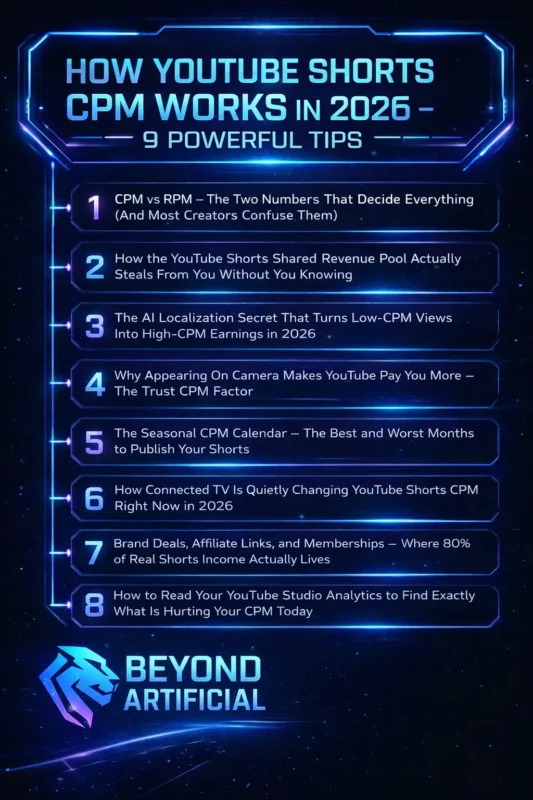
In this article, we will break down 9 powerful tips that explain how YouTube Shorts CPM works in 2026, helping you understand the numbers and build a smarter strategy to grow your YouTube income. To understand the full earning system behind Shorts, it also helps to learn YouTube Shorts monetization works and how revenue is distributed to creators.
Keep reading to discover the powerful strategies that can help you understand YouTube Shorts CPM in 2026 and turn your views into real income.
1. CPM vs RPM: The Two Numbers That Decide Everything (And Most Creators Confuse Them).
Many creators feel excited when they see a high CPM in YouTube Studio. They quickly calculate how much money they should earn and then check their payout, only to feel disappointed. This happens because CPM (Cost Per Mille) shows how much advertisers pay YouTube for 1,000 ad impressions, not how much the creator actually receives. The number that really matters is RPM (Revenue Per Mille). RPM shows the actual earnings a creator keeps after YouTube takes its share and after non-monetized views are included. For example, if your CPM is $10, your real RPM may be closer to $5.50 after YouTube’s cut.
On YouTube Shorts, it can be even lower because not every view shows an ad. That is why RPM is the most important metric for creators. It tells you what your content is truly earning. If your CPM looks good but your RPM stays low, it usually means your audience is from low-CPM countries, your content is mostly Shorts, or advertisers are not paying much for your niche.
To understand your real earnings, open YouTube Studio, go to Analytics, click Revenue, and focus on your RPM instead of CPM. This simple habit can help you understand where your money is really coming from. For Shorts, RPM is usually very low, often between $0.01 and $0.06 per 1,000 views. That means 1 million Shorts views might earn only $10 to $50. Because of this, smart creators treat Shorts as a growth tool to attract new viewers, while long-form videos generate the real advertising revenue.
Once you understand the difference between CPM and RPM, you stop feeling confused about your earnings and start building a smarter YouTube strategy that focuses on both audience growth and higher revenue.
2. How the YouTube Shorts Shared Revenue Pool Actually Steals From You Without You Knowing.
One thing many creators do not realize is that YouTube Shorts earnings do not come from ads on your specific video. Instead, all Shorts ad revenue is placed into a shared pool. From this pool, YouTube calculates how much each creator earns, which is why the final payout is often much smaller than creators expect. First, YouTube collects all ad revenue from the Shorts feed and creates a Creator Pool. The amount that goes into this pool also depends on music usage.
If your Short uses no music, it keeps 100% of its revenue share in the pool. If it uses one music track, the share drops to 50%, and if it uses two tracks, it can fall to about one-third. This means that using copyrighted music can significantly reduce the amount of revenue connected to your Short. Next, YouTube distributes money from the Creator Pool based on your share of total engaged views in each country.
For example, if your Shorts receive 5% of the eligible views in the United States, you earn 5% of the US Creator Pool. However, you are competing with every other monetized creator uploading Shorts at the same time, so your share can become smaller as more creators join the program. After this calculation, YouTube gives creators 45% of their share and keeps 55%. This is different from long-form videos, where creators usually receive 55% of the ad revenue.
A smart strategy to improve earnings is to use original audio or voiceovers instead of copyrighted music. Shorts with original sound often keep more monetizable revenue because there are no music licensing fees. YouTube also increased ads in the Shorts feed during 2025–2026, which slightly increased the total revenue pool. However, the number of creators has also grown, so competition is stronger than ever. Because of this, many successful creators upload 1–2 Shorts daily, focus on strong hooks in the first few seconds, and choose topics with long-term search interest instead of only chasing trends.
The reality is that Shorts alone rarely generate large income. Many creators use Shorts mainly to grow their audience and drive viewers to long-form videos, where ad revenue is much higher. While 1 million Shorts views might earn $30–$100, the same number of views on a long-form video can sometimes generate $1,000 to $30,000, depending on the niche and audience.
3. The AI Localization Secret That Turns Low-CPM Views Into High-CPM Earnings in 2026.
Here is a story that shows how powerful audience location can be on YouTube. Raj, a tech YouTuber in Mumbai with 84,000 subscribers, earned about $340 in one month. Meanwhile, his friend Tom in London, who had only 42,000 subscribers, earned $4,820 in the same month. Their content quality, niche, and upload schedule were similar. The only difference was their audience location. Tom’s viewers were mostly from the US and UK, while Raj’s audience was mainly from India and Southeast Asia.
This example shows why high-CPM countries matter so much. In 2026, one of the smartest ways creators are solving this problem is through AI localization. Instead of publishing content in a single language, creators now dub their videos into other languages to reach viewers in higher-paying regions. YouTube already offers automatic dubbing features, but creators who use professional AI dubbing tools often get better quality and higher viewer retention.As a result, the algorithm starts showing its content to new international audiences, which can increase CPM and overall revenue.
Many creators have already seen strong results. Some channels that added multiple language audio tracks gained millions of additional views from new countries. Markets such as Germany, Spain, and other European regions still have less competition, creating a strong opportunity for creators who localize their content early. A good starting strategy is simple: target English and German first. English content often has some of the highest CPM rates, while German opens access to the Germany, Austria, and Switzerland markets.
The best part is that AI dubbing in 2026 is much cheaper than traditional dubbing, so creators can reach global audiences without spending a lot of money. Your action step is simple: select one of your best-performing Shorts, add English or German dubbing, and republish it for international viewers. Then check your YouTube Studio audience geography data over the next few weeks. You may quickly discover that reaching a global audience can significantly increase your CPM and overall earnings.
Creators who understand the YouTube Shorts algorithm changes can reach higher-value audiences and improve their overall CPM potential.
4. Why Appearing On Camera Makes YouTube Pay You More, The Trust CPM Factor.
Here is something many creators do not realize: channels where the creator appears on camera often earn higher CPM than faceless channels. When viewers see a real person, they usually trust the content more. This trust is important because advertisers prefer to place ads on channels where the audience feels a stronger connection with the creator. In 2026, YouTube is full of AI-generated and faceless content, so advertisers have become more selective. Brands in niches like finance, technology, and education often choose channels where a real person speaks directly to the audience. These viewers are more likely to engage with ads, buy products, and follow recommendations.
Because of this, human-on-camera content usually receives higher advertiser bids. Faceless channels can still earn money, but channels with a visible host often sit in the higher CPM range. The good news is that you do not need expensive equipment to benefit from this. Even a simple phone camera and natural lighting are enough. Some creators start by showing their face in a small picture-in-picture frame while explaining their content. Speaking directly to the viewer and maintaining eye contact with the camera can also help build trust quickly.
In many cases, creators in niches like finance, education, and personal development earn $10–$30 CPM, while many faceless entertainment channels earn around $1–$5 CPM. The difference usually comes from the human connection viewers feel. So if you want to improve your earnings, try adding your face and voice to some of your Shorts. Over time, this can increase audience trust, improve engagement, and potentially raise your RPM and CPM on YouTube.
5. The Seasonal CPM Calendar: The Best and Worst Months to Publish Your Shorts.
Many creators make a costly mistake without realizing it: they upload their Shorts whenever they feel like it and never think about timing. But the truth is that YouTube CPM changes throughout the year, and the same video can earn very different amounts depending on when people watch it. The highest CPM usually happens in Q4 (October to December). During this time, advertisers spend much more money because of Black Friday, Cyber Monday, and Christmas shopping. Because of this competition, CPM rates can be 20–50% higher than the yearly average.
On the other hand, January and February often have the lowest CPM. Many companies reduce their advertising budgets after the holiday season, so CPM can drop 20–40%. This does not mean something is wrong with your channel; it is simply a normal seasonal pattern that affects all creators. Smart creators use this pattern to their advantage. Instead of worrying about low CPM early in the year, they focus on growing their audience and improving their content during these months.
A great strategy is to publish your best Shorts in August and September. This gives the YouTube algorithm several weeks to push your content and build engagement before the high-CPM months of November and December arrive. When CPM rises, your already-performing videos can earn more money. Timing also matters within the week. Many creators see good results by publishing on Tuesday or Wednesday afternoon in their audience’s main time zone, when more viewers are active.
So instead of feeling discouraged during low-CPM months like January, use that time to grow your audience, improve retention, and post consistently. Then, when the high-CPM season arrives in Q4, your larger audience and stronger videos can turn those higher ad rates into much better earnings.
6. How Connected TV Is Quietly Changing YouTube Shorts CPM Right Now in 2026.
One of the biggest changes affecting YouTube CPM in 2026 is something many creators do not notice: Connected TVs (CTV). Today, more than 45% of YouTube watch time happens on TV screens, where viewers watch from their living rooms. These viewers usually spend more time watching and are more likely to buy products, which is why advertisers often pay higher CPM to reach them. This is especially important for Shorts creators. A YouTube Short often acts as a discovery tool. If someone finds your content through a Short and then watches your long-form video on a TV, that viewer can be worth 10–20 times more in ad revenue compared to someone quickly watching a Short on their phone.
Because of this, many successful creators now use Shorts as a gateway to their long-form videos. The Short grabs attention, and then it encourages viewers to watch a deeper video on the same topic. Another important tip is video quality. Uploading videos in 4K resolution can signal higher quality to YouTube’s advertising system. Some creators have even seen large increases in revenue after switching to higher-quality visuals.
To take advantage of this trend, try using each Short as a preview or trailer for a longer video. At the end of the Short, add a clear call-to-action like “Watch the full video on my channel.” This can guide viewers from Shorts to your long-form content, where CPM is usually much higher. It also helps to optimize long-form videos for TV viewers. Avoid extremely fast editing, add clear chapters, and make the content comfortable to watch on a large screen.
The CTV trend is already transforming YouTube. Creators who understand how to connect Shorts with high-quality long-form content are often the ones who see the biggest growth in both views and earnings.
7. Brand Deals, Affiliate Links, and Memberships: Where 80% of Real Shorts Income Actually Lives.
Here is an important truth about YouTube Shorts income that many creators do not realize. Most successful creators do not earn most of their money from CPM or ad revenue. Instead, they make much more from brand deals, affiliate links, and channel memberships. For example, creator Jenny Hoyos built over 1.5 million subscribers with fewer than 100 Shorts, and one of her biggest earnings came from a $15,000 brand deal, not from ad revenue alone. This shows that the real money often comes from business opportunities around your audience, not just views.
In fact, a creator with only 10,000 highly engaged subscribers can sometimes earn $2,000–$5,000 from a single brand deal, which could be more than what millions of Shorts views generate through ad revenue. Smart creators treat Shorts as a growth tool, not the main product. Shorts help you attract viewers quickly, and then you monetize that audience in different ways.
A simple 3-step income strategy works well for many creators. First, enable channel memberships once you reach around 500 subscribers, which can create a steady monthly income from loyal fans. Second, use affiliate links. A good method is the problem–solution format, where you show a problem and then recommend a product that solves it. This type of Short often converts better than long product reviews. Third, start looking for brand deals when your engagement rate is strong, even if your channel is still small. Companies care more about active audiences than just subscriber numbers.
You can also increase affiliate clicks by using product tags, pinned comments, and description links so viewers can easily find the product you mention. The strategy that works in 2026 is simple: Use Shorts to grow your audience quickly, then combine memberships, affiliate marketing, and brand deals to build real income. When you do this, ad revenue becomes a helpful bonus, not the main source of money.
8. How to Read Your YouTube Studio Analytics to Find Exactly What Is Hurting Your CPM Today.
Many creators open YouTube Studio, look at their earnings for a few seconds, and close the page. But this habit can cost you money. The Revenue tab in YouTube Studio shows key metrics such as CPM and RPM, helping you identify which videos generate the most revenue and which audiences are most valuable.
To check this, go to YouTube Studio → Analytics → Revenue. Here you can see your CPM and RPM for different videos and time periods. One important metric to watch is Playback-based CPM. This shows the amount advertisers paid when an ad was played during your video. If your regular CPM is high but the playback-based CPM is much lower, it means many of your views are not showing ads. If your views are increasing but earnings stay low, the problem is usually one of these:
- Your audience is mostly from low-CPM countries
- Your videos are too short for mid-roll ads
- You are posting during low-advertising months like early Q1
- Your niche attracts lower-paying advertisers
You can run a simple weekly check to improve your earnings. Open Analytics → Revenue, set the date range to the last 28 days, and note your RPM. Then check Audience Geography to see where your viewers are coming from. Finally, sort your videos by RPM and study the ones earning the most to understand what works best.
To increase RPM, make sure monetization is enabled on all videos, use mid-roll ads for long videos over 8 minutes, and activate extra features like memberships or Super Chat if they are available. Spending just 10 minutes each week reviewing your analytics can help you understand what is working and what is not. Over time, this small habit can help you improve your strategy and increase your overall YouTube earnings.
9. The Final YouTube Shorts CPM Blueprint, 9 Powerful Tips That Work Together as One System.
Now everything becomes clear. You have learned that CPM and RPM are different, that the Shorts revenue pool reduces earnings, and that factors like audience location, niche, on-camera trust, seasonal timing, and CTV viewers all affect how much you earn on YouTube.
The key idea is that these tips work best together, not separately. When you combine the right audience, strong content, and multiple income sources, your earning potential grows much faster. Use Shorts as your growth engine to reach more viewers quickly. Then guide those viewers to long-form videos, where CPM and revenue are usually higher. At the same time, add other income sources like brand deals, affiliate links, and channel memberships so your channel becomes a real business instead of relying only on ad revenue.
Review your YouTube Studio analytics regularly, improve what works, and keep testing new ideas. Once you apply these strategies, you will understand YouTube Shorts monetization better than most creators, and you will be in a much stronger position to grow both your channel and your income.
FREQUENTLY ASKED QUESTIONS (FAQs).
What is the RPM of YouTube Shorts in 2026?
In 2026, the average YouTube Shorts RPM is usually between $0.01 and $0.06, which means most creators earn about $10–$60 for every 1 million views. This happens because Shorts’ revenue comes from a shared ad revenue pool, not direct ads on each video. However, creators in high-value niches like finance, tech, or business, especially with viewers from Tier-1 countries, can reach RPM levels of $0.15–$0.25. Many successful creators also increase their income by adding brand deals, affiliate links, and memberships, instead of relying only on Shorts ad revenue.
What is the YouTube algorithm of 2026?
In 2026, the YouTube Shorts algorithm focuses on showing the right video to the right viewer. Shorts and long-form videos are now ranked separately, so poor Shorts performance will not hurt your long-form content. When you upload a Short, YouTube first shows it to a small test audience. If viewers watch instead of swiping away, replay it, or engage with it, the algorithm pushes the video to a much larger audience. The most important factor is the Viewed vs. Swiped Away ratio, so a strong hook in the first 2 seconds and good viewer retention can help your Short reach many more people.
How much is CPM for YouTube Shorts?
In 2026, the average CPM for YouTube Shorts ads is around $4, which is what advertisers pay YouTube for every 1,000 ad impressions. However, creators do not receive the full amount. After the shared revenue pool distribution, music licensing costs, and YouTube’s 45% share, most creators earn about $0.03–$0.10 per 1,000 views. This is why Shorts usually pay less than long-form videos. The good news is that advertising on Shorts is growing quickly, so CPM and earning potential are expected to increase in the coming years.
Do longer Shorts make more money?
Not necessarily. Longer Shorts do not automatically earn more. What matters most is viewer retention—how long people watch your video. A shorter 30–60 second Short with strong retention or loops can perform better than a longer Short where viewers leave early. In general, Shorts earn much less per view than long-form videos, so many creators use Shorts to attract viewers and then guide them to long-form videos (8+ minutes) where ad revenue and CPM are much higher.
How much YouTube Shorts pays for 100k views
In 2026, 100,000 YouTube Shorts views usually earn about $3–$7 on average. This is because Shorts’ revenue comes from a shared ad revenue pool, which spreads earnings across billions of daily views. In comparison, long-form videos can earn much more per view, especially in high-paying niches. For this reason, many creators use Shorts mainly to grow their audience and then guide viewers to long-form videos, brand deals, or affiliate links, where the real income potential is higher.
How youtube shorts cpm works in 2026 calculator
If you have ever used a YouTube Shorts earnings calculator and felt disappointed by the result, you are not alone. Many creators enter their view count and expect a big number, but the estimate often looks much lower than expected. This happens because Shorts’ earnings are based on RPM and a shared revenue pool, not a simple payment for every view.
Most calculators use a basic formula like this:
Views ÷ 1,000 × RPM × 0.45 (the creator’s share after YouTube’s cut). Because of this system, the result can look small, but the calculator is still useful. Instead of seeing it as bad news, you can use it to understand what factors you need to improve to increase your earnings.
Use these inputs to analyze your potential income:
- Your Monthly Views → Enter the real number from YouTube Studio Analytics to get a more accurate estimate.
- Audience Location → Viewers from countries like the US, UK, or Norway often generate much higher CPM than viewers from lower-CPM regions.
- Your Niche → Niches like finance or investing usually earn much higher CPM than niches like gaming or entertainment.
- Music Usage → Using licensed music can reduce the revenue connected to your Short, while original audio can help keep more of your share.
- Your Income Goal → Instead of guessing, work backwards. Decide how much you want to earn and use the calculator to estimate how many views and what type of audience you need.
A calculator should not discourage you. It should help you understand which factors to improve so you can move closer to the income you want from your YouTube content.