
 YouTube Automation
How Much Does it Cost to Start An Online Business-7 Best ways(Blog#:09)

If you have been stuck in the 9-to-5 grind, dreaming of freedom but worried about the costs, you are not alone. How Much Does it Cost to Start an Online Business might surprise you: your biggest barrier is not money, it’s fear disguised as “not enough funds.” You do not need thousands in the bank to start making income online. What you really need is clarity on the best ways to launch without breaking the bank and the courage to take your first step today.
Starting an online business can be affordable and manageable if you know where to focus. From leveraging free tools and platforms to choosing low-cost marketing strategies, there are 7 proven ways to get your business off the ground while keeping expenses minimal. The key is to plan smart, act boldly, and remember that every big online business started small.
Once you take that first step, momentum will build, opportunities will appear, and your dream of freedom will not feel so far away anymore.
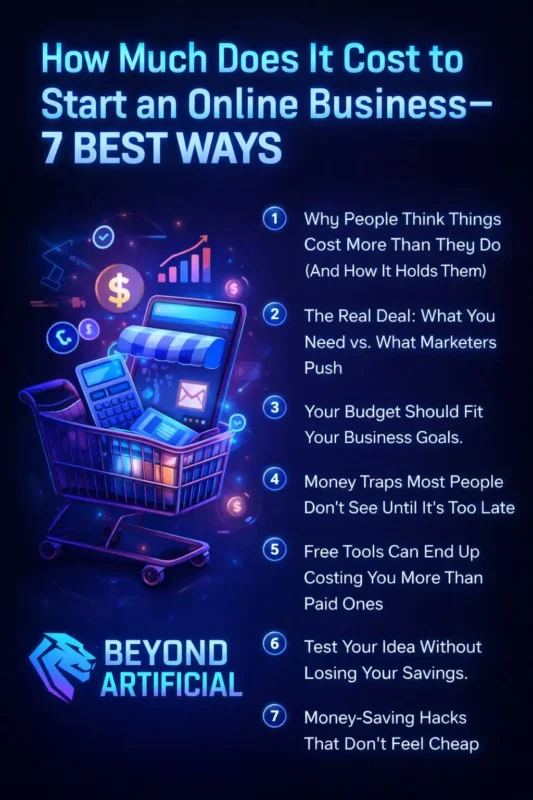
Keep reading to discover the real costs of starting an online business and the 7 smartest ways to launch without draining your savings.
1. Why People Think Things Cost More Than They Do (And How It Holds Them Back)
You have seen entrepreneurs brag about “$10,000 launches” and websites that cost more than a car, and suddenly, your dream feels impossible. That’s because your brain remembers the expensive stuff, fancy logos, premium tools, paid ads, but forgets the thousands who started with just $50 and a lot of hustle. This mental trap keeps you stuck, thinking you need “just a little more money” before starting. The truth? You are scared and using cost as an excuse.
Here is the shift: track what successful people spent in their first month, not what they spend now. Set a “failure budget” of $100–$500, money you are okay losing. This kills the fear of losing your savings. Focus on solving one person’s problem this week instead of building a perfect business. Momentum beats fear faster than any bank balance.
Remember: broke people who act beat rich people who wait for perfect conditions. Your real competitor? Someone braver than you to start messy.
2. The Real Deal: What You Need vs. What Marketers Push.
Marketing gurus make starting an online business feel like a shopping spree. They say you “need” a $2,000 website, $500/month email software, and a dozen tools before making your first sale, but that’s mostly to keep you buying instead of building. The truth: most successful entrepreneurs started with just three things: a way to collect money, a way to deliver value, and a way to reach people. Everything else came later, after they were already earning.
The essentials, a domain, basic hosting, and a payment processor, cost less than your monthly Netflix and coffee. Here is the hack: list only what you need to make your first $100, not a million, and do not buy anything else until that money hits your account. Use free tools until they break. Test your offer with a simple Google Form and PayPal before spending on fancy funnels.
Stop letting software companies occupy your brain—you’re building a business, not collecting subscriptions. Scrappy creativity beats expensive perfection every time.
3. Your Budget Should Fit Your Business Goals.
You would not buy a Ferrari to learn how to drive, but people spend their savings on premium business tools before making a single sale and then wonder why they feel stressed instead of excited. Your budget is not about having “enough money.” It’s about matching your spending to where you really are in your journey, not where you dream of being in five years. A freelancer selling their time might only need $200 to start. Someone building a product empire might need $5,000.
Mixing these up leads to overspending and stress or underspending and failure. Here is the reality check: write down your actual goal for the next 90 days, making your first $1,000, quitting your job, or testing an idea, and build a budget that only serves that goal. If you are validating an idea, spend $0–$100. Scale spending with revenue, not dreams.
Only upgrade to paid tools after you have made 3X their cost. Stop treating your budget like a vision board, your money should work as hard as you do. Keep it safe until your business proves it deserves more.
4. Money Traps Most People Do not See Until It’s Too Late.
The sneakiest costs are not the ones you plan for; they are the $15 monthly subscriptions you forgot to cancel, the 3% transaction fees eating your profits, and “essential” app upgrades that pile up until you are paying $300/month for a business making $400. Free trials seem harmless, but six months later, you are funding software you barely use.
These hidden costs don’t just drain your money; they drain your motivation, because you are feeding tools instead of serving customers.
Here is how to fight back:
1. Set reminders two days before every trial ends and cancel anything you haven’t used in the last week.
2.Check payment processors and e-commerce platforms—low fees often hide extra costs.
3. Make a “subscription jail” spreadsheet with all recurring charges and audit it monthly.
Every dollar saved on unnecessary tools is a dollar you can spend reaching real customers. Profit is not just about making more, it’s about keeping more.
5. Free Tools Can End Up Costing You More Than Paid Ones
Free tools sound great, until you spend 40 hours fighting a clunky website builder that a $15/month tool could have solved in two hours. Then you realize your time is worth far more than the money you “saved.” The real cost of free tools is not the price; it’s the extra hours, missing features, and lost credibility when glitches cost you real customers. Choosing free can end up being penny-wise, pound-foolish.
Here’s the fix: figure out what one hour of your time is worth. Track how many extra hours a free tool costs you. If a $30/month tool automates tasks and prevents mistakes, it’s often cheaper than the time and revenue you lose using free tools.
Use paid tools only for core money-making tasks—payment processing, customer communication, product delivery. For everything else, stay free until it blocks a sale. Free is fine—until it costs you a customer.
6. Test Your Idea Without Losing Your Savings.
The biggest mistake is not a bad idea; it’s spending thousands building something nobody wants before talking to a single customer. You can test almost any idea for under $50: pre-sell it, post about it on social media, or just ask people if they would pay. Most skip this step because they love building more than selling. Your savings are not a slot machine; they are your safety net. Smart entrepreneurs protect it by testing cheap and scaling only after proof shows demand.
Here is a simple playbook:
1. Make a landing page with free tools like Carrd or Google Sites.
2. Clearly show what you are offering and the price.
3. Spend $20 on Facebook or Instagram ads to see if anyone clicks.
4. Run a pilot with 3–5 customers at a discount for feedback and testimonials.
5. Use pre-orders or crowdfunding so customers fund your product before you spend your own money.
Set a hard validation budget of $100. If demand is not proven by then, your idea needs work. The market does not care about your passion; it cares about solving problems people will pay for.
7. Money Saving Hacks That Do not Feel Cheap.
Being broke and being strategic look very different to customers. One feels desperate, broken links, blurry logos. The other shows confidence, smart choices that save you thousands, but nobody notices. The key is knowing where to splurge for perception (what customers see) and where to cut costs behind the scenes (what they do not). You can make your business look million-dollar-ready on a $100 budget. Professionalism is not expensive—it’s consistent, clear, and easy for people to buy from.
Here is how to cut without hurting credibility:
1. Use Canva Pro ($13/month) instead of hiring a designer, you save $500+ and still look polished.
2. Buy a premium WordPress theme ($59) instead of paying $2,000+ for a custom site. Customize it yourself with YouTube tutorials.
3. Use customer photos and testimonials instead of professional photography: real people convert better than stock photos.
4. Barter services with other entrepreneurs: trade copywriting for bookkeeping, and save cash while building relationships.
Invest your money where it matters most: fast website, smooth checkout, responsive support. Cheap here costs sales; smart spending builds trust.
FREQUENTLY ASKED QUESTION(FAQs)
What business has a 90% success rate?
No business comes with a guaranteed 90% success rate; anyone claiming that is selling a fantasy, not reality. The safest bets are usually service-based businesses like consulting, freelancing, or coaching, because they need almost no startup money, and you get paid while learning. Success does not come from the business type; it comes from your willingness to adapt, listen to customers, and keep going when things get tough.
Do I need an LLC to run an online business?
You do not need an LLC to start making money online; you can sell legally today as a sole proprietor. An LLC becomes important once you are earning consistently or face risks like contracts, employees, or physical products, because it protects your personal assets from business debts and lawsuits. Start small, prove your business works by making $5,000–$10,000, and then upgrade to an LLC when the protection is worth the cost.
What are common business mistakes?
The biggest mistake new businesses make is spending months perfecting a product instead of selling an imperfect version to real customers who can tell you what they actually want. Many also waste money on fancy branding, websites, and tools before proving that anyone will pay, then run out of cash before their first sale. Avoid this by launching fast and simple, talking to customers constantly, keeping costs low, and remembering that messy action always beats perfect planning.
What to avoid when starting a business?
Do not spend months building in secret without talking to customers; you might end up making something nobody wants and call it “bad luck” instead of bad research. Avoid wasting money on fancy logos, expensive tools, and perfect websites before your first sale; focus on reaching people and solving their problems. Stop over-planning, comparing yourself to established businesses, and waiting for the “perfect time”; your competitors are starting messy, learning fast, and taking the customers you’re too scared to reach.
What are the 7 stages of startup?
The 7 startup stages are:
Idea/Validation
Pre-Seed (building your first product)
Seed (first customers and revenue)
Early Growth (scaling what works)
Growth/Expansion (hiring and systems)
Maturity (established market position)
Exit or Renewal (selling, going public, or reinventing)
Most beginners focus too much on stages 5–7, when they should be focused on stages 1–3, proving people will pay, making first sales, and reinvesting profits. Right now, your goal is to survive long enough to reach the next stage, not plan an exit years away. Crawl, walk, then run.
How much does it cost to start a small business?
That number, $500, $5,000, or even $50,000, hurts a lot of new entrepreneurs. But here isthe truth: the exact figure matters far less than what you actually do with the resources you already have. Most people never start because they are waiting for a “safe” amount that will somehow remove all risk, but no such number exists. Every business comes with some risk, and the only thing you can control is how wisely you spend what you have. The real cost is not just dollars, it’s the regret of never trying, the missed lessons, and the opportunities that slip by while you wait for the perfect budget.
What really determines your startup costs:
Business model: Selling services is much cheaper than making physical products.
DIY tolerance: Doing tasks yourself saves big on hiring help.
Timeline pressure: Rushing always costs more than planning strategically.
Quality standards: Starting “good enough” is far cheaper than aiming for perfect.
Existing resources: Skills, connections, and equipment you already have can drop costs close to zero.
Most people never start a business because they are waiting for the “perfect” budget, thinking there is a safe number that eliminates risk. The truth is, there is no risk-free amount; what matters is taking action with what you already have. Focus on starting small, using your existing skills and resources, and learn as you go, because real progress beats waiting for perfection every time.
