
 YouTube Automation
Do AI Humanizers Work? 9 Hidden Truths(Blog#:33)

Have you ever seen an “AI-detected” warning and felt frustrated after putting in so much effort? If yes, you are not alone. That is exactly why the question “Do AI humanizers work?” has become so important today. Writers, students, bloggers, and professionals are all searching for ways to make AI-generated text sound more natural and human.
Many people turn to AI humanizer tools hoping they will fix robotic sentences and help them bypass AI detection. But the big question remains: Do AI humanizers work the way people expect? The truth is, some tools improve readability, while others barely change anything. The results depend on how the tool works, how you use it, and what AI detector is being tested against.
In this article, we will break down 9 honest truths to help you clearly understand do AI humanizers work, when they fail, and how to use them the right way for better results
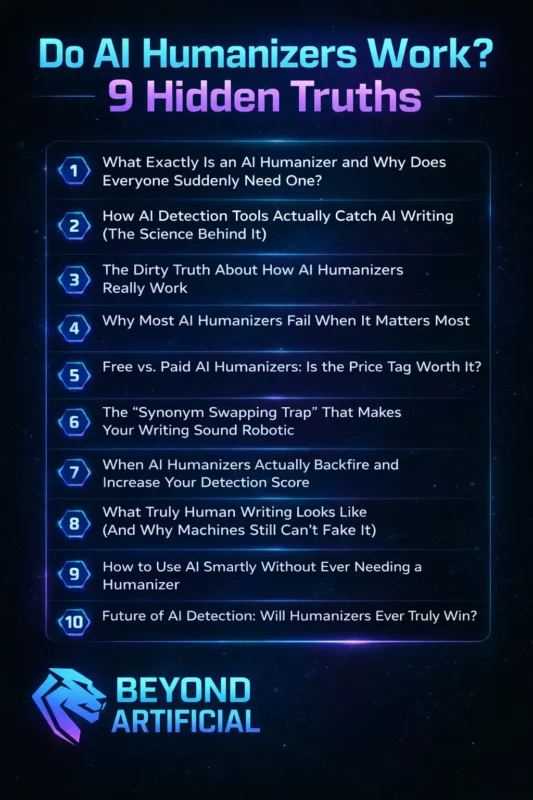
Keep reading to uncover the truth that most AI humanizer tools do not want you to know.
1. What Exactly Is an AI Humanizer and Why Does Everyone Suddenly Need One?
Imagine spending hours creating an essay or article with AI, and then it gets flagged as AI-written. That disappointing feeling is exactly why AI humanizers exist. An AI humanizer is a tool that tries to make AI-generated text sound more natural. It changes sentence structure, replaces certain words, and improves the flow so the content feels more human.
Today, many people use these tools because AI detectors have become very advanced. Teachers, editors, and even clients are checking content more strictly than before. Here is an important tip: before using any AI humanizer, read your content out loud. You will quickly notice which sentences sound robotic or unnatural. Another smart step is to add your own experiences, opinions, or a small, relatable example. That personal touch makes your writing more real and much harder to flag.
You should also mix short and long sentences on purpose. Real human writing is not perfectly structured. It has natural variation. Most importantly, treat AI as your first draft helper, not your final writer. Always edit the content with your own voice and personality. That is what truly makes your writing natural and powerful
2. How AI Detection Tools Actually Catch AI Writing (The Science Behind It)
Have you ever noticed that no matter how much you edit your AI content, the detection tool still flags it? It can feel frustrating and even unfair. AI detection tools are not magic. They look at writing patterns. Two important things they measure are perplexity and burstiness. In simple words, they check how predictable and how uniform your text is. AI usually writes in very smooth and perfectly structured patterns, more perfect than real humans.
These detectors are trained on millions of AI-written texts. That is why they can recognize certain hidden patterns left by tools like ChatGPT, even if the words look completely normal. Here is your first tip: break the “perfect” pattern. Use contractions like “don’t” or “it’s.” Add a casual phrase sometimes. Perfect grammar all the time can actually look suspicious. Another smart tip is to change your sentence rhythm. Write one long sentence, then a short one.
Then a medium one. Real human writing has natural ups and downs. Also, avoid starting many sentences the same way. Words like “furthermore” and “additionally” used again and again can make your writing sound robotic. Most importantly, stop trying to trick the detector. Instead, focus on writing with real emotion and personal opinion.
When your writing feels genuine and natural, it becomes much harder to flag and much more powerful to read.
3. The Dirty Truth About How AI Humanizers Really Work.
You probably paid for an AI humanizer tool with high hopes, thinking it would finally fix your AI detection problem. But here is the truth most tools do not tell you. Many AI humanizers only replace words and slightly change sentence structure. For example, they change “utilize” to “use” or move sentences around. But the deeper AI patterns often stay the same, and that is what detection tools actually look for.
Advanced detectors like Turnitin do not just check words. They analyze the structure and patterns of your writing. So simply changing vocabulary is often not enough. Here is your first tip: always test a humanizer tool before using it for important work. Run the text through more than one detector, such as GPTZero and Copyleaks. Passing one tool does not guarantee you will pass another.
Another honest tip: avoid using humanizers in your introduction and conclusion. These sections need emotion and personal voice. Humanizer tools often make them sound unnatural or weak. You should also manually rewrite a large part of the content yourself, at least 30–40%. Focus especially on paragraph openings and transitions. That is where AI patterns are usually most obvious.
Most importantly, think of AI humanizers as a starting point, not a final solution. Your own editing, even if it is imperfect, will always sound more real than any tool trying to imitate human writing.
4. Why Most AI Humanizers Fail When It Matters Most.
Most AI humanizers fail at the exact moment you need them most, when your grades, job, or reputation are on the line. They promise “undetectable” results, but many only change a few words while the deeper AI patterns stay the same, which is why detectors still catch them. That is why it feels so frustrating and unfair, especially after you paid money and trusted the tool to protect your hard work.
Here is the first tip: never rely on a humanizer alone, always read the output slowly and edit it in your own natural voice. Add one small personal opinion, a short real-life example, or even a simple emotional reaction, because that human touch makes a real difference. Another smart tip is to rewrite the introduction and conclusion completely by yourself, since those sections carry your tone and are easiest for detectors to analyze.
Most importantly, treat AI humanizers as helpers, not heroes, because your imperfect, honest editing will always be stronger than any tool trying to sound human for you.
5. Free vs. Paid AI Humanizers: Is the Price Tag Worth It?
Free AI humanizers look very attractive because they cost nothing, and when you are stressed about detection, it feels like a quick and easy solution. Paid tools, on the other hand, promise deeper rewriting, smarter algorithms, and better chances of passing AI detectors, which makes you think the price must mean better protection. But the truth is that many people pay with high hopes and still feel disappointed when their content gets flagged again.
Here is the first tip: never trust marketing claims alone; test both the free and paid versions using at least two different AI detectors before making any decision. Another important tip is to carefully compare the output side by side and see if the paid version truly changes sentence structure and flow, or if it just replaces a few words with synonyms.
If you decide to invest in a paid tool, treat it as a helper, not a magic fix, and always rewrite the most important parts like your introduction, conclusion, and transitions in your own voice. At the end of the day, what truly makes your content safer and more powerful is not whether it is free or paid, but how thoughtfully you edit and personalize it after the tool has done its part.
6. The “Synonym Swapping Trap” That Makes Your Writing Sound Robotic.
The synonym swapping trap is one of the biggest reasons your writing still sounds robotic, even after using an AI humanizer. These tools often just replace simple words with fancier ones, thinking that changing help to assist or use to utilize will magically make the content human. Instead of sounding natural, your writing starts to feel forced, awkward, and strangely emotionless, and deep down, you can feel something is off.
Here is the first tip: always choose clarity over complexity, because real humans prefer simple, clear words that flow naturally. Another smart tip is to read your sentences out loud and ask yourself, “Would I actually say this in real life?” If the answer is no, rewrite it in your own comfortable tone. Try shortening long, over-polished sentences and add small personal touches like opinions or reactions, because that instantly breaks the robotic rhythm.
Most importantly, remember that sounding human is not about using bigger words; it is about sounding real, imperfect, and emotionally connected to what you are saying.
7. When AI Humanizers Actually Backfire and Increase Your Detection Score.
Here is the hard truth no one talks about: sometimes the tool you trust to fix your AI detection problem can actually make it worse. When AI humanizers backfire, they often increase your detection score by turning your writing into something overly polished and repetitive. Instead of sounding natural, the text can feel too perfect, and that is exactly what many AI detectors are trained to catch.
Here is your first important tip: never run your content through a humanizer more than once, because every extra pass removes the small imperfections that make writing feel real. Another smart tip is to mix the humanized text with sentences you write completely on your own, since that natural blend makes the content sound more authentic. You should also carefully edit any sentences that feel too smooth, too formal, or slightly awkward after humanizing, because those are often the ones that trigger detection tools.
The best approach is to treat AI humanizers as a starting helper, not a final fix, and rely on your own editing to truly make the content sound human.
8. What Truly Human Writing Looks Like (And Why Machines Still Can not Fake It)
There is something special and unpredictable about real human writing that machines still cannot copy. Human writing shows emotion, small imperfections, and personal experiences that make it feel alive and genuine. AI can create clean and polished sentences, but it often misses the natural tone shifts and honest moments that real people include without even thinking.
Here is your first tip: add small personal stories, simple opinions, or real feelings into your writing, because that authenticity makes your content stronger and more natural. Another helpful tip is to mix your sentence lengths, write one short sentence, then a longer one, since that natural rhythm is how people truly communicate. You can also use casual phrases, ask a quick question, or even admit a small doubt, because that vulnerability makes readers trust you more.
The moment you stop trying to sound perfect and start writing in your true voice is the moment your content feels real, and that is something no AI tool can fully replace.
9. How to Use AI Smartly Without Ever Needing a Humanizer.
What if you never needed an AI humanizer at all? What if you could use AI in a smarter way so your content sounds human from the very first draft? The real problem is usually not the AI; it is how people use it. Many users copy and paste the output without guiding it properly or adding their own personality. When you treat AI like a helper instead of a replacement for your voice, everything changes.
Here is your first powerful tip: give AI very clear and detailed prompts. Tell it your tone, your target audience, and even how you want the writing to feel. The more human your instructions are, the more natural the result will be. Another important habit is to never publish AI content as it is. Always read it out loud, rewrite a few sentences in your own voice, and add one small personal opinion or example. That simple step makes your content feel authentic.
You can also use AI mainly for ideas, outlines, or research, and then write the final sentences yourself. This way, you get speed from AI but keep the heart and personality in your writing. The smartest creators are not the ones who avoid AI or fully depend on it; they are the ones who use AI as a tool while keeping their own human voice strong and clear in everything they create.
10. Future of AI Detection: Will Humanizers Ever Truly Win?
AI detection is improving much faster than most people think, and many are wondering if AI humanizers will ever truly win. The honest answer is that detection tools keep getting smarter, and every time humanizers find a way to bypass them, the detectors quickly update and close that gap. It has become an ongoing cat-and-mouse game, and in the long run, humanizers may never fully stay ahead because companies are constantly investing in better detection systems.
That is why your most important future-proof step is to stop depending completely on humanizers and start building your own real writing voice. Another smart tip is to stay updated on AI detection trends by reading trusted blogs and testing tools regularly, so you understand how the technology is changing. You should also begin writing more of your first drafts yourself and use AI mainly for ideas or light editing, because that habit will protect you as detection systems grow stronger.
In the end, the writers who succeed will not be the ones chasing the newest tool, but the ones who focused early on developing a strong, honest, and truly human voice.
FREQUENTLY ASKED QUESTIONS (FAQs).
Can an AI humanizer be detected?
Yes, an AI humanizer can still be detected, and modern detection tools are becoming very good at spotting humanized content. The main issue is that many humanizers rewrite text in predictable ways, and advanced tools like Turnitin and GPTZero already recognize those patterns. The smarter approach is to rely less on tools and add your own voice, personal thoughts, and natural imperfections, because real human input is something no detector can truly copy or flag.
Does Turnitin detect humanized AI?
Yes, Turnitin can detect humanized AI content, so relying only on a humanizer is risky. Turnitin’s system is trained to notice the subtle patterns and overly polished style that many humanizer tools create, even if the text looks natural at first glance. The safest approach is to rewrite important parts in your own voice, add real opinions or examples, and use AI only as a helper, because your genuine input is what truly makes the work feel original and human.
Does undetectable AI actually work?
“Undetectable AI” sounds like the perfect solution, but the truth is that no tool can promise 100% undetectable results every time. Some advanced tools may work better than basic humanizers and can bypass certain detectors for a while, but detection technology keeps improving and quickly catches up. The safest strategy is to use these tools only as support, then rewrite the content in your own voice and add real thoughts or experiences, because that human touch is what truly makes your work feel natural and secure.
Can GPTZero humanize?
Here is something many people do not realize: GPTZero is a detection tool, not a humanizer. It was created to identify AI-written content, not to hide or rewrite it. Some writers get confused because GPTZero shows exactly which parts look like AI, and they think it can also fix them, but that is not its purpose. The smart way to use GPTZero is as a testing tool: run your content through it, see which sentences are flagged, and then rewrite those parts in your own natural voice until the text sounds truly human.
How to 100% humanize AI text?
Everyone wants that perfect 100% humanized result, but the truth is that no tool or shortcut can fully humanize AI text without your involvement. The closest you can get is by combining smart tools with your own editing, rewriting robotic sentences in your natural voice, adding real experiences, and mixing up your sentence lengths so the rhythm feels human. The best method is simple: let AI create the basic structure, then rewrite it with your own words, personality, and small imperfections, because that human touch is what truly makes your content feel authentic.
Do AI humanizers work on Turnitin?
That stressful moment when you submit your assignment to Turnitin and keep refreshing the page, hoping the score stays low, is something many students understand very well. If you have been asking, “Do AI humanizers work on Turnitin?” you are definitely not alone. Turnitin has become much more advanced, and it now looks for AI writing patterns, not just copied content. That is why many basic AI humanizer tools do not work as well as people expect.
The good news is that there are smart and practical ways to feel more confident before submitting your work. When you understand how Turnitin analyzes writing and what patterns it looks for, you can adjust your content more smartly. Instead of relying only on tools, you can focus on improving your own writing habits and adding your personal voice.
Here are some important things to remember:
1. Turnitin can detect AI-style writing patterns, not just plagiarism
2. Most simple humanizer tools struggle against advanced detection systems
3. Your natural voice and personal input are your strongest protection
4. Smart editing habits are more powerful than any automatic tool
5. Real solutions exist, and they start with how you write, not just what tool you use
AI humanizers can help, but they are not magic; real protection comes from how wisely you use them and how much of you is in the final draft. The writers who truly stay safe are the ones who guide AI smartly, edit deeply, and never publish without adding their own voice and emotion. In the end, no tool can replace authenticity; your human touch is the only strategy that will always work.