
 YouTube Automation
Why People Stop Watching Your Videos – 9 Powerful Reasons(Blog#: 70)

You worked hard on your video, but people still stopped watching before the best part. That feeling when you check your retention graph and see viewers dropping off, it hurts. It feels like all your effort is being ignored.
But here is the truth: people are not leaving because your content is bad. They are leaving because their brain quickly decides if your video is worth their time, usually in just a few seconds. Most creators do not realize this. Small psychological triggers make viewers stay… or leave.
Once you understand the 9 real reasons why people stop watching your videos, you will not just improve your watch time, you will finally connect with your audience the right way.
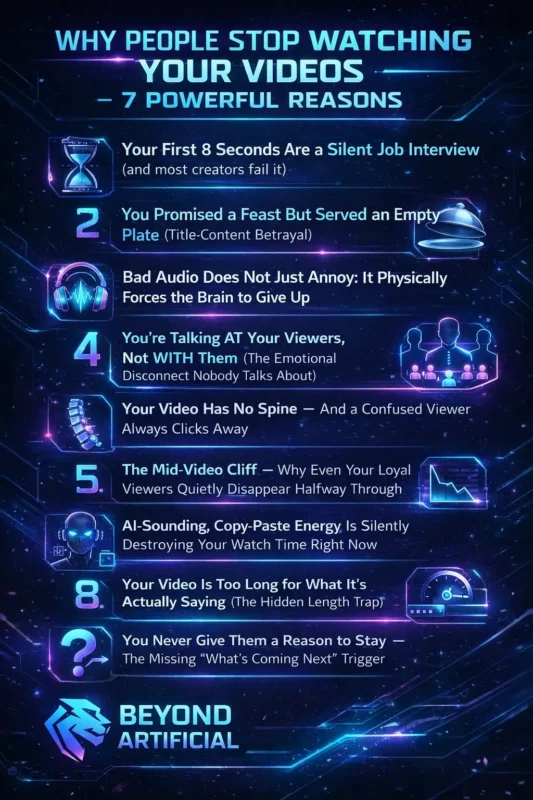
1. Your First 8 Seconds Are a Silent Job Interview (and most creators fail it).
Every time someone clicks your video, the first 8 seconds quietly decide what happens next. But most creators waste this moment by saying, “Hey guys, welcome back to my channel…” while their viewers are already thinking about skipping. Here is the reality: your viewer’s brain makes a quick decision in just a few seconds. Is this worth my time or not? And if you do not give a strong reason to stay, they leave without thinking twice.
The hard truth is, your content might actually be amazing… But if the beginning feels slow, unclear, or generic, people will never stay long enough to see it. So instead of starting with your name or logo, start strong. Open with something that grabs attention instantly:
- a bold question
- a surprising fact
- or a quick preview of the best part coming later
Make the viewer feel as if they leave now, they will miss something important. Keep your hook short under 10 seconds and make sure it clearly answers the one question every viewer has: “What is in this for me? Also, add energy in those first moments. Use quick cuts, zooms, or text on screen, because the human brain reacts to movement.
If your video starts slowly and statically, it quietly tells the viewer, “This might be boring.” Now go to your YouTube Analytics and check your retention graph.
If you see a big drop in the first 30 seconds, that is not bad luck; it is your hook telling you it needs to be fixed.
2. You Promised a Feast But Served an Empty Plate (Title-Content Betrayal).
When your title promises something powerful, but your video takes too long to deliver it or does not deliver it at all, viewers do not just leave; they feel disappointed. And that feeling is dangerous, because it breaks something more important than views: trust. This mismatch between your title and your content is one of the biggest reasons people stop watching your videos.
The moment someone clicks, their brain already expects you to deliver what you promised. If you break that expectation, especially in the first 60 seconds, they leave quickly and may never come back. The hard part is, you probably did not mean to trick anyone. You just wanted more clicks.
But your viewers do not see your intention; they only see the result. And when people leave too fast, YouTube’s algorithm notices and starts pushing your video down. So what should you do instead? Before finalizing your title or thumbnail, ask yourself one honest question: “Does my video clearly deliver this promise within the first 2 minutes?” If the answer is no, do not change the video first; fix the title.
Also, make sure your thumbnail shows something real from the video: a real result, a real reaction, or a clear moment. This way, when someone clicks, they instantly feel like they got what they expected. Think of it like this: your title is the menu, and your video is the food. If you promise a delicious steak but serve plain rice, the viewer will leave, and they won’t come back. So keep your titles honest, clear, and specific.
The good news is, you do not need to exaggerate to get clicks. A simple, curiosity-driven, honest title works better in the long run, because viewers who trust you stay, and viewers who stay are exactly what YouTube rewards.
3. Bad Audio Does Not Just Annoy: It Physically Forces the Brain to Give Up.
Here is a truth most creators never hear: when your audio quality is bad, your viewer’s brain has to work extra hard just to understand what you are saying. And that effort is tiring. So tiring that the brain quietly decides, “This is not worth it,” and the viewer clicks away, sometimes without even knowing why. Bad audio does not just annoy people.
It actually drains their energy.
The worst part is, viewers usually do not think, “This audio is bad.” They just feel uncomfortable and slowly lose interest. And when that discomfort gets linked to your video, they leave, taking their watch time and trust with them. You might have amazing, valuable content in your video, but if your audio is unclear, echoey, or full of background noise, most people will not stay long enough to hear it.
The good news is, fixing your audio is not as hard or expensive as you think. You do not need a full studio setup. Even a simple external microphone can make a huge difference; it is one of the best upgrades you can make. Also, your environment matters. Try recording in a small, quiet space with soft surfaces. A carpeted room or even a closet full of clothes works really well, because soft materials absorb sound and reduce echo.
This helps you avoid that hollow, “bathroom-like” sound that pushes viewers away. Another important habit: Always listen to your recording with headphones before you publish. Sometimes audio issues aren’t obvious while recording, but they become very clear when you play it back. And if you use background music, keep it very low, lower than you think.
If your music starts competing with your voice, your viewer’s brain has to choose what to focus on, and most of the time, they give up and leave. Even small improvements like better audio can change your results, and understanding the video editing cost in 2026 helps you invest wisely.”
4. You are Talking AT Your Viewers, Not WITH Them (The Emotional Disconnect Nobody Talks About).
There is a big difference between a creator who talks and a creator who truly connects. And viewers can feel that difference within the first 30 seconds, even if they can not explain it. When you say “Hey, guys,” it feels like you are talking to a crowd. But when you say “Hey, you,” it feels personal, like you are speaking directly to one person. That small change creates a powerful connection.
Many creators think low watch time is caused by poor editing or slow pacing. But sometimes, the real problem is emotional distance. When a viewer feels like “this person is just performing, not talking to me,” They feel disconnected… and leaving becomes easy. This happens very quickly. The brain reacts to emotions almost instantly. So before your viewer even thinks about whether your content is useful, they’ve already decided how your video feels. If your energy is low, your eyes aren’t focused on the camera, or your words feel forced or scripted, the viewer senses it and slowly loses interest.
So how do you fix this? Start with one simple habit: stop looking at yourself on the screen and look directly into the camera lens. That eye contact makes each viewer feel like you are talking directly to them. Next, change your language. Instead of saying “everyone” or “guys,” use “you.” Write your script like you are helping one real person with a real problem. That personal tone builds a much stronger connection.
Also, be real. Share a mistake, a struggle, or something you have experienced. When viewers see themselves in your story, they feel more connected, and they stay longer. And at the end of your video, ask one genuine question. Not something generic like “comment below,” But a real question that shows you actually care about their answer. Because the moment a viewer feels heard, your video stops being one-sided and becomes a real connection.
And that is what turns casual viewers into loyal audiences who keep coming back.
5. Your Video Has No Spine, And a Confused Viewer Always Clicks Away.
Imagine going to a restaurant where the waiter keeps bringing random dishes with no order, no explanation, and no clear plan. You would feel confused… frustrated… and probably leave. That is exactly how your viewer feels when your video has no clear structure, no flow, no direction, no sense of where it is going. Confusing pacing and unclear storytelling are some of the biggest reasons people click away. And the worst part? They will not tell you.
They just leave quietly… while your retention graph shows that painful drop. A video without structure is not just messy; it breaks a psychological expectation. What makes content memorable isn’t just the information… It is the way that information is organized into a clear story. Without that structure, your viewer’s brain has nothing to follow and no reason to stay. So how do you fix this?
Start before you even record. Write one simple sentence: “By the end of this video, my viewer will feel/know/be able to…” If you can not clearly complete that sentence, your video is not ready yet. Next, use a simple structure: Why → What → How Start with Why (first 15–30 seconds): explain why this matters to the viewer
Then what: explain the idea clearly. Then, how: show how to apply it. This gives your viewer a clear path to follow, and when the brain sees a clear path, it stays.
You can also add YouTube chapters. Not just for navigation, but to show your video is organized and easy to follow. This makes viewers feel like their time is respected. Also, stay focused. Do not jump between random topics. Stick to one clear idea so your viewer does not get lost. And finally, pay attention to how you end your video. Do not drag it out with lines like “finally…” or “hope you enjoyed…” These signals make viewers leave before you are even done.
Instead, end clean and strong, right after your final point. Because a sharp ending shows confidence… and respect for your content and your audience. f your videos feel unstructured, using the best collaborative video editing tools can help organize your content better.”
6. The Mid-Video Cliff: Why Even Your Loyal Viewers Quietly Disappear Halfway Through
This is the part that hurts the most. Your viewer liked your video enough to stay after the hook… They trusted you enough to watch halfway… and then suddenly, they are gone. No warning. No comment. Just gone. Most creators do not even notice this mid-video drop, because they focus so much on fixing the beginning that they ignore what is happening in the middle. But the truth is, many videos lose viewers halfway through. This is where viewer fatigue starts. People get tired, lose focus, or feel like their energy has dropped.
And if nothing changes, they leave. What is surprising is that most advice online only talks about the first 30 seconds… But the middle of your video is just as important, and just as dangerous. In fact, only a small number of videos keep more than 50% of viewers watching. On average, most videos lose the majority of viewers before reaching the best parts.
That means by the time you get to your most valuable content… a lot of your audience is already gone. So how do you fix this? Start using something called a mid-video re-hook. Every 60–90 seconds, remind viewers why they should keep watching. Say things like: “In a moment, I’ll show you the part that changes everything…” Or “The next tip is the one most people miss, and it is why they stay stuck…” This builds curiosity and keeps people engaged. Next, use pattern interrupts. Every 60–90 seconds, add something new:
- a zoom
- a sound effect
- text on screen
- a quick story
- or a change in tone
These small changes wake the viewer up and reset their attention. Also, go check your YouTube Analytics. Do not just look at the start, look at the middle of your video.
Find the point where viewers drop off. Then ask yourself honestly:
- Did I slow down here?
- Did I go off-topic?
- Did I stop giving value?
Your retention graph is showing you exactly where things went wrong. Another important point: Very few viewers actually reach the end of your video. So do not wait until the last 10 seconds to ask people to subscribe or click a link. Instead, place your call-to-action in the middle, where your most engaged viewers are still watching.
7. AI-Sounding, Copy-Paste Energy Is Silently Destroying Your Watch Time Right Now.
Here is a truth most creators do not want to admit: Your viewers are smarter than you think. In 2025, people can quickly sense when content feels fake, copy-pasted, or too robotic. They may not say, “This is AI-generated,” but they feel something is off, a kind of coldness that makes them lose interest. And when that happens, they leave. Content that feels low-effort or overly AI-generated often keeps far fewer viewers. Not because AI is bad, but because it lacks personality.
If your script sounds generic, your voice feels flat, and your video looks like hundreds of others… you are not just losing watch time, you are losing trust. And trust is much harder to rebuild. Here is something important: People are not watching for perfection. They are watching for you.
- Your real voice.
- Your opinions.
- Your small mistakes.
- Even your awkward pauses.
Those human moments are what make your content feel alive, and alive content keeps people watching. So what should you do? Start by changing how you write. Do not write like an article? Talk like you are explaining something to a friend. Use natural language: “Okay, wait…” “Here’s the thing…” “Let me explain this simply…” That slightly messy, conversational style actually makes you feel more real. Next, add something personal to every video.
Not something vague like “I’ve been there too,” but something specific, like: “Last week, I made this exact mistake, and here is what happened…” Specific details make your content feel authentic, and that is something no generic script can copy. Right now, a big portion of content online is AI-generated. Which means your biggest advantage is simple: Be real. In a world full of similar, robotic content, real human energy stands out.
And that is what makes people come back again and again. So try this: Go back to your last 3 videos. Listen to them without watching. Then ask yourself honestly:
“Does this sound like me… or does this sound like everyone else?” Because if you can not tell the difference, your viewers already can, and they are quietly deciding whether to stay or leave. To avoid robotic content, using the best AI tools for video editing in 2026 can help you add a more human touch.”
8. Your Video Is Too Long for What It Is Actually Saying (The Hidden Length Trap)
Let us be honest. If your video is 15 minutes long, but the real message could be said in 4… your viewers feel that. They may not know exactly why, but they lose interest, and they leave. The real problem is not that your video is “too long.” It is that it is too long for the value it gives. And that is a silent mistake that slowly kills your retention and your growth. YouTube does reward watch time… but a shorter, focused video with strong retention often performs better than a long video that people do not finish.
So what should you do? Start with one simple question before you record: “What is the ONE main thing this video needs to say?” If something does not support that main idea, it probably does not need to be there. Every extra minute without a clear value is a chance for your viewer to leave. Also, do not waste time at the start. Skip long intros and get straight to something interesting, a strong visual, a question, or the main point.
Because most viewers decide very quickly whether they want to keep watching. Another powerful step: Open your YouTube Analytics and check your retention graph. Look for the exact moment where viewers drop. That sudden drop is not random; it is showing you exactly where something went wrong. If you see a big fall where many viewers leave at once, go back to that moment and ask:
- Did I slow down here?
- Did I go off-topic?
- Did I add something unnecessary?
Then edit it. Do not hesitate, cut it. Because every small improvement in pacing helps keep viewers watching longer. If you are struggling with long, unfocused videos, following a proper complete AI video editing process you stay clear and concise.
9. You Never Give Them a Reason to Stay, The Missing “What is Coming Next” Trigger.
Let us be honest, this is one of the most painful mistakes creators make without even realizing it. You explain one point… then simply move to the next… without giving your viewer any reason to stay. And in that moment, their finger is already moving toward the “next video” button. What is missing here is something very important:
a “what is coming next” trigger. This is like an invisible thread that pulls viewers through your entire video. Without it, your content feels directionless, like a road with no signs.
And when people feel lost, they leave. Because viewers do not just watch information… They follow a journey. So if you do not give them a reason to keep going, they will stop watching. So how do you fix this? Start adding small curiosity hooks throughout your video. Every 2–3 minutes, say something like: “But wait… the real trick is coming up.”……“In a moment, I will show you the part that changes everything.” “Here is what most people miss…”
These short lines create curiosity and keep people interested in what’s coming next. You can also use simple phrases like: “Coming up next…” Or “Let me show you this part…”
“Do not miss this…” These act like bridges that guide your viewer forward. Another powerful trick: Remind your viewers what they will gain by staying. You do not need to repeat everything; just a small reminder is enough to keep their interest alive. And if your video is longer than 10 minutes, do one more thing:
At the beginning, give a quick roadmap. For example: “First we will cover this… then we will move to this… and finally I will show you this.” When viewers know what’s coming, they feel more comfortable, and they are more likely to stay until the end.
FREQUENTLY ASKED QUESTIONS (FAQs)
Why do people dislike your videos?
People usually dislike videos when the title or thumbnail promises something exciting, but the content does not deliver it. This creates a broken expectation, and viewers feel disappointed. Other common reasons include content that feels weak or biased, and pacing that is too slow or boring. The solution is simple: always deliver what your title promises, keep your content honest and well-paced, and focus on what your audience already enjoys. When you consistently meet expectations, dislikes naturally decrease, and viewer trust starts to grow.
Why are my videos not getting views?
If your videos are getting zero views while you keep refreshing and hoping for results, the truth is your content is not being discovered. This usually happens because of weak titles, poor descriptions, and thumbnails that do not attract clicks. Even great videos can stay invisible if they are not packaged properly. Most videos fail when creators ignore basics like keyword optimization, strong thumbnails, and consistent uploads.
The solution is simple: find the right keywords using tools like TubeBuddy or VidIQ, create bold and eye-catching thumbnails, and start your videos with a strong hook to keep viewers watching. Once people start clicking and staying, YouTube will begin pushing your videos to a wider audience.
What’s the most disliked video?
The most disliked video on YouTube is YouTube Rewind 2018, mainly because it felt fake and disconnected from the real community. The key lesson is simple: when your content stops feeling authentic, viewers do not just leave, they push back. Always stay real, deliver what you promise, and connect with your audience to build trust.
What is the 8-minute rule on YouTube?
The 8-minute rule means videos longer than 8 minutes can have ads in the middle, which helps you earn more. But do not stretch your video with filler, add real value so viewers stay, and your video performs better.
What is the 30-second rule on YouTube?
The 30-second rule means the first 30 seconds of your video are critical. If viewers get bored and leave early, your video will not t get recommended. So start strong with something interesting, keep viewers engaged, and your chances of growing on YouTube will increase.
Why people stop watching your videos on YouTube
You spent hours filming, editing, and uploading your video with high hopes… Then you opened YouTube Studio, checked your retention graph, and felt your heart drop. Viewers were leaving within the first 30 seconds. That feeling hurts.
And here is the hard truth: Many viewers leave because they are not getting what they expected. That means every click-away is not just a lost view, it is a broken expectation between you and your audience. But here is the good news, most blogs do not tell you: Your content is probably not the problem. Your structure is, and that is something you can fix starting today.
Once you understand the real reasons why viewers leave, you will be able to:
- Grab attention in the first 5 seconds so viewers do not even think about leaving
- Fix pacing and delivery mistakes that quietly kill your watch time
- Create a clear video structure that keeps people watching from start to finish
- Turn your retention graph from a drop into a steady line, and get better results from the algorithm.