
 YouTube Automation
Is YouTube Automation Worth It – 7 Proven Truths(Blog#:58)

Every night, you might find yourself thinking, “Is YouTube automation worth it, or am I just wasting my time?” You are not alone; thousands of people feel the same after seeing high-income claims online that do not always feel real. The truth is, this question comes from people who genuinely want to make money online but are confused about what actually works.
Maybe you have tried before, faced some failure, or started doubting yourself, and that is completely normal. In this guide, you will learn 7 proven truths that show what really works in YouTube automation and what separates successful creators from those who quit too early.
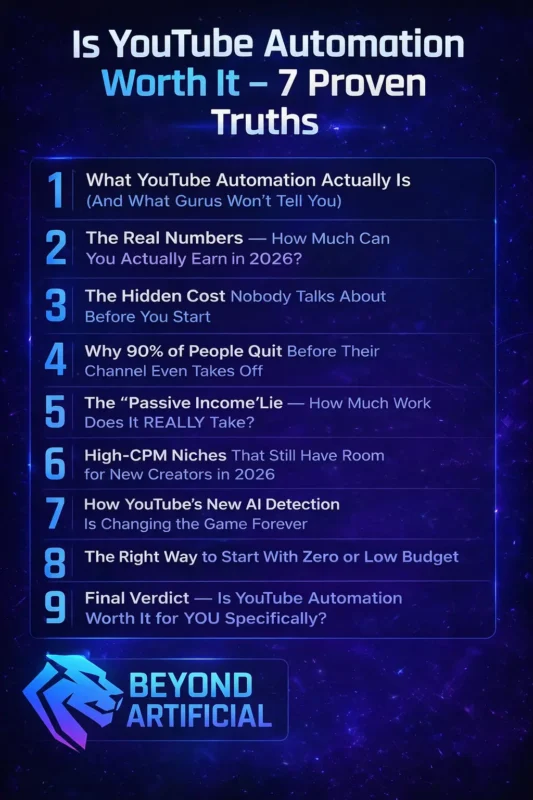
Keep reading to uncover the real truth behind YouTube automation and see if it is truly worth your time.
1 . What YouTube Automation Actually Is (And What Gurus Would not Tell You)
YouTube automation sounds like a dream: build a faceless channel, let AI do the work, and watch money flow in while you sleep, but the real truth is far more layered than any guru’s income screenshot will ever show you. At its core, YouTube automation means running a channel without appearing on camera, using AI tools, freelancers, or smart systems to handle scripting, voiceovers, editing, and publishing.
But here is what nobody tells you: you are still the brain, the strategist, and the decision-maker behind every single move. Most people enter this space believing “automation” means pressing one button and disappearing, only to feel blindsided, frustrated, and financially drained when reality hits them hard. So the first tip is this: stop seeing yourself as a passive investor and start seeing yourself as a silent CEO who builds, manages, and grows a media business from behind the scenes. Your second tip is to completely ignore any course or guru that promises results in 30 days, because real automation channels take 6 to 18 months of consistent, strategic effort before they generate meaningful income.
The third tip is to treat your channel like a small business from day one, pick one niche, master one content format, and build one repeatable system before you ever think about scaling. Once you understand that automation is not about doing nothing, but about doing the right things smarter, everything clicks, and that’s exactly when your channel starts growing in a way that finally feels worth it.
2. The Real Numbers: How Much Can You Actually Earn in 2026?
Here is the honest truth: most beginners earn nothing in the first 4–6 months, and that is where many people quit. It is not the algorithm that stops them; it is the silence and slow start. In 2026, once a channel gets monetized, beginners usually earn around $500 to $2,000 per month, while established channels in niches like finance or tech can earn $5,000 to $20,000+, but this takes time, usually 1–2 years of consistent work.
One important thing many people do not understand is the difference between CPM and RPM. CPM is what advertisers pay, but RPM is what you actually earn after YouTube’s cut, and it is always lower. Tip 1: Always focus on RPM, not CPM. RPM is your real income, so base your expectations on that. Tip 2: Reinvest your early earnings. Instead of spending money, use it to improve your content, better scripts, voiceovers, and thumbnails. Tip 3: Choose a high-paying niche from the start. Niches like finance, tech, or online business pay more per view compared to entertainment or gaming.
When you understand these basics, YouTube stops feeling like luck and starts feeling like a real business you can grow step by step.
3. The Hidden Cost Nobody Talks About Before You Start.
When you start YouTube automation, most people only talk about the income, but not the real costs. What starts as $50 per month for tools can quickly grow to $200 as you add more software for editing, SEO, and analytics. The bigger reality is that many beginners invest $3,000+ and create 30+ videos before seeing real results. This takes time and patience.
Also, it is not fully passive at the start. Even if you outsource, you still need to spend time managing work, reviewing videos, and improving your content. That’s why many people feel overwhelmed. Tip 1: Set a clear monthly budget before starting. Know how much you can spend for at least 2–3 months without pressure.
Tip 2: Start with low-cost or free tools. Use simple AI tools to test your niche before spending a lot of money. Tip 3: Use safe, licensed content. Always use free or paid stock footage to avoid copyright issues and extra costs later. When you understand the real costs and plan properly, you stop feeling confused and start treating your channel like a smart business.
4. Why 90% of People Quit Before Their Channel Even Takes Off.
If you have ever uploaded a video, kept refreshing your analytics again and again, and thought “maybe this is not for me”, you are not alone. This is the exact moment where most creators quit. The hard truth is, many people give up just before their channel starts improving. Most beginners also do not realize how long this takes. In 2026, reaching monetization in 4–6 months is actually fast.
When results do not come quickly, self-doubt starts to grow, and quitting begins to feel like the only option. Another big mistake is spending money too early. Many people hire editors or voiceover artists before even knowing if their idea works, and this leads to frustration and loss of money. Tip 1: Commit to at least 50 videos before judging your results. Success takes time, and consistency is what matters most.
Tip 2: Do not compare yourself to others. What you see online is their final result, not the long struggle behind it. Tip 3: Test your niche first. Try your first few videos yourself before spending money, so you understand what your audience actually wants. Most people who quit were not less capable, they just stopped too early. If you keep going, you give yourself a real chance to succeed.
5. The “Passive Income” Lie: How Much Work Does It REALLY Take?
Let’s be honest, YouTube automation is not truly “passive income.” It is better to think of it as leveraged work. Once you understand this, you stop feeling confused and start making real progress. In reality, making just 2–3 videos per week can take 15–25 hours. You have to research, manage scripts, review edits, and upload videos — especially in the beginning when you’re doing most of the work yourself.
The first few months are the hardest. You need time, effort, and patience, even when results are slow.
Tip 1: Stop thinking “passive” and start thinking “leveraged.” You’re building systems now that will save you time later. Tip 2: Organize your work. Set specific days for tasks like research, scripting, and reviewing. Use AI tools to save time and make things easier. Tip 3: Focus on reaching your first 30 videos. After that, your process becomes smoother, and your workload starts to decrease.
When you understand this mindset, the journey feels less frustrating and more like a smart business you are building step by step. If you want a deeper breakdown of income sources, check this guide on YouTube automation that makes money.
6. High-CPM Niches That Still Have Room for New Creators in 2026.
Choosing the wrong niche is one of the biggest mistakes you can make. It does not just waste money, it wastes your time and motivation, too. In 2026, some of the best niches are finance, tech, business, health, and AI. These topics pay more and have a strong demand. But the real opportunity is not in broad topics — it is in specific sub-niches.
For example, instead of “finance,” you can focus on something like “insurance for seniors.” These small niches have less competition but high earning potential. A good niche is where people are searching, but good content is limited. That’s where you can grow faster.
Tip 1: Always research your niche first. Use tools like VidIQ or TubeBuddy to check if people are searching for it and if the competition is low. Tip 2: Plan your content around high-paying months. Earnings are usually higher at the end of the year, so take advantage of that. Tip 3: Stay consistent in one niche. Don’t switch too early — give at least 50 videos before deciding to change.
When you choose the right niche and stay consistent, your channel starts to grow like a real business instead of a random experiment.
7. How YouTube’s New AI Detection Is Changing the Game Forever.
Imagine working on your YouTube channel for months, putting in time, effort, and money, and suddenly your channel gets removed. This actually happened in 2026 when YouTube updated its rules and started taking action against low-quality AI content. YouTube did not ban AI; it only targets content that is fully automated and lacks real human input. If your videos look like copy-paste or mass-produced content, your channel can be at risk.
Today, YouTube can detect patterns like repeated scripts, robotic voiceovers, and too many uploads with similar content. So uploading a large number of low-quality videos is no longer a good strategy.
Tip 1: Always add your own thoughts or ideas to your videos. Even a small human touch makes your content safer and more unique. Tip 2: Review your old videos. Improve titles, thumbnails, and descriptions slowly instead of changing everything at once. Tip 3: Use AI as a helper, not as a replacement. Let AI assist with ideas and editing, but make sure your final content reflects your own voice and decisions.
When you use AI the right way, it becomes your advantage instead of a risk, and helps your channel grow safely. To understand the process better, you can explore this detailed YouTube automation workflow with AI tools.
8. The Right Way to Start With Zero or Low Budget.
If you have been waiting to start YouTube automation because of money, here is the truth: it is much cheaper now. In 2026, you can create videos at a very low cost, so money is no longer a big barrier. At the beginning, your goal is not full automation; it is to build a simple system you can repeat, learn from, and improve over time. You can start with a low budget using basic tools for scripting, voiceovers, and video creation.
Even with a small monthly cost, you can create your first few videos and test your ideas. Tip 1: Do not spend money too early. Use free tools first and create a few videos to see what works before upgrading. Tip 2: Work in batches. Instead of making one video daily, create 3–5 videos in one session to save time and stay consistent. Tip 3: Set a clear upgrade point. For example, once you earn your first money or reach a milestone, reinvest it into better tools or help.
When you start with what you have and improve step by step, you realize that budget is not the problem, consistency and smart decisions are.
9. Final Verdict: Is YouTube Automation Worth It for YOU Specifically?
After reading all this, the real question is not “does YouTube automation work?”, it is “does it work for you?” The honest answer is yes, but only if you treat it like a real business, not a shortcut. YouTube automation can work in 2026 if you are ready to stay consistent, invest time, and focus on quality. But if you expect quick money or can not handle slow results, it may not work for you right now.
There are creators who earned a lot but lost everything because they focused on low-quality, mass content instead of real value. So the problem is not automation, it’s the wrong approach.
Tip 1: Ask yourself three things: can you give 10–15 hours weekly, survive without income for a few months, and stay patient during slow growth? If yes, you’re ready. Tip 2: Create a simple 90-day plan. Decide your niche, posting schedule, and goals, and stick to it. Tip 3: Treat your first channel as learning. Your first 30–50 videos are for experience, not just income.
YouTube automation is not for everyone, but if you stay patient and consistent, it can become a powerful online business.
YouTube automation works, but only when done right. That’s why creators trust our YouTube automation services for consistent results.
FREQUENTLY ASKED QUESTIONS (FAQs)
Is YouTube automation a good career?
Yes, YouTube automation can be a good career in 2026, but only if you treat it like a real business, not a quick side experiment. Creators who succeed focus on the right niche, use AI tools smartly, and keep improving their content. Over time, this can grow into a stable, location-free income. The key is simple: stay consistent, think long-term, and build systems that help your channel grow.
What is the success rate of YouTube automation?
Only about 5–10% of people succeed in YouTube automation, not because others lack talent, but because they quit too early. Those who succeed choose a good niche, stay consistent, and learn from their mistakes instead of giving up. If you stay patient and treat it like a real system, your chances of success become much higher.
Does YouTube pay for 3,000 watch hours?
No, YouTube does not pay you for 3,000 watch hours. To start earning, you need 1,000 subscribers and 4,000 watch hours in the last 12 months, or 10 million Shorts views in 90 days. Once you reach this, apply for monetization and start earning from your content.
Can I use AI for YouTube automation?
Yes, AI is allowed in YouTube automation and can make your work much faster and cheaper. The important rule is simple: use AI as a tool, not a replacement. Add your own ideas and creativity to keep your content original and safe. When used correctly, AI can help you create high-quality videos in less time and grow your channel faster.
Is it too late to start a YouTube channel?
No, it is not too late to start YouTube in 2026. There are still billions of users and plenty of opportunities for new creators. Success today is not about being first; it is about being better and creating quality content. Start with one niche, stay consistent, and focus on value. The sooner you begin, the better your chances of success.
Is YouTube automation worth it in 2026
The truth is simple: YouTube automation for beginners does work, but only if you treat it like a real business, not a shortcut. If you stay consistent, focus on value, and build your system step by step, a faceless YouTube channel can grow into a real income source over time. But if you expect fast results, easy money, or fully passive income from day one, this model will disappoint you. Success here comes from patience, learning, and improving with every video you create.
The good news is, you do not need to be perfect to start. You just need to start smart, stay consistent, and keep improving.YouTube automation is worth it in 2026 , but only with the right mindset
- Faceless YouTube channels can grow without showing your face
- Beginners succeed when they focus on learning, not on quick money
- Consistency and patience matter more than tools or shortcuts
- Your first few videos are your learning phase, not your final result