
 YouTube Automation
How To Make YouTube Shorts Go Viral – 9 Powerful Tips(Blog#:54)

You may have watched many viral Shorts, studied popular hooks, and used trending sounds, yet your videos still get very few views. That can feel frustrating and discouraging. The truth about How To Make YouTube Shorts Go Viral is that many creators focus on the wrong things. They spend too much time on editing and effects while ignoring the key signals the algorithm actually cares about.
The YouTube Shorts algorithm mainly looks at viewer engagement, such as average view duration, completion rate, and whether people watch the video again. These factors matter far more than production quality, subscriber count, or how long you have been on the platform. Once you understand this, the whole strategy becomes much clearer. The good news is that making viral Shorts is not just about luck or trends.
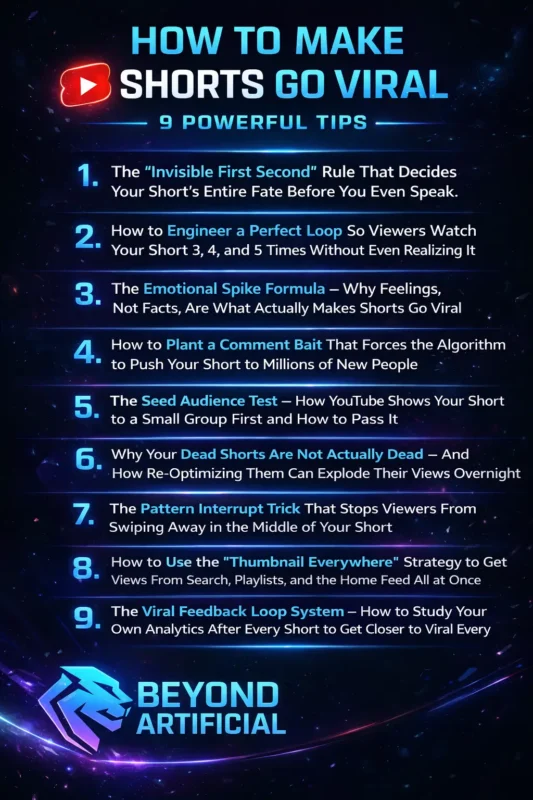
If you want to combine viral content with a smart posting plan, you should also learn the best YouTube Shorts posting strategy to grow your channel consistently.
It is a skill you can learn and improve. In this guide, you will discover 9 powerful and practical tips that can help you create Shorts that the algorithm is more likely to promote, so your content can reach more viewers and grow your channel. Keep reading to discover the exact strategies that can help your YouTube Shorts reach more viewers and finally start gaining real momentum.
1. The “Invisible First Second” Rule That Decides Your Short’s Entire Fate Before You Even Speak.
Here is something that can completely change the way you create YouTube Shorts. The algorithm does not wait to see if your video is good before deciding how many people will see it. Every new Short is first shown to a small group of viewers, and the algorithm quickly checks one thing: do viewers stay, or do they swipe away? This decision often happens in the very first second, even before you start speaking.
Shorts that grab attention in the first 1–2 seconds keep far more viewers than videos that start slowly. If the first frame looks boring, many viewers will swipe away immediately, no matter how good the rest of the video is. That means your opening moment is extremely important. So here is a powerful tip: design your first frame carefully. Start with something that instantly catches attention, such as bold on-screen text, a surprising visual, an interesting close-up, or a moment that makes viewers curious.
Strong hooks often use simple ideas like a bold claim, a curiosity gap, a short story opening, a surprising visual, or a direct question. Another useful step is to check your Viewed vs. Swiped Away data in your analytics. Shorts with a higher percentage of viewers who stay tend to perform much better, while videos with many quick swipes usually stop getting promoted.
Avoid slow introductions or long greetings. Instead, start with the most interesting moment right away. When you focus on that first second, your chances of reaching more viewers can improve dramatically.
2. How to Engineer a Perfect Loop So Viewers Watch Your Short (3, 4, and 5 times without even realizing it)
Many creators spend a lot of time perfecting the hook at the beginning of a Short, but they forget about the ending. This is a common mistake because the ending plays a big role in whether viewers watch the video again. Replays are very valuable, since each time someone watches your Short again, it counts as another view. That is why creating a loop can make a big difference. A loop happens when the ending of your Short smoothly connects back to the beginning, making the video feel continuous.
There are two simple types of loops. A story loop makes viewers curious enough to watch again, while a visual loop ends with a frame that looks almost the same as the opening frame. A helpful tip is to plan your ending before you plan your beginning. If the ending naturally leads back to the start, viewers are more likely to replay the video without even realizing it. Another strategy is to add small hidden details or changes in the video so viewers feel curious and watch again to notice them.
Shorts that are about 7–15 seconds long are often easier to loop and rewatch. Also, try to use audio that ends smoothly so the transition back to the start feels natural. When your Short encourages replays, those extra views can help send stronger signals to the algorithm and increase your chances of reaching more people.
3. The Emotional Spike Formula (why feelings, not facts, are what actually make shorts go viral)
You may notice that the YouTube Shorts you remember the most are not always the ones that teach the most information; they are the ones that make you feel something quickly. This happens because strong emotions capture attention and make people want to keep watching, commenting, or sharing the video. Research shows that high-energy emotions like surprise, excitement, or awe can lead to more shares than neutral content.
Many creators focus only on tips or facts, but they forget that viewers connect more with videos that create a clear emotional moment. A helpful strategy is to create a simple emotional transformation in your Short. Ask yourself one question before filming: “What will my viewer feel at the end of this video that they did not feel at the beginning?” For example, a video might move from confusion to clarity, from worry to relief, or from curiosity to surprise.
Another useful tip is to add an emotional hook in the first few seconds. Starting with an exciting, surprising, or meaningful moment can quickly capture attention and stop viewers from swiping away. When your Short creates a strong emotional response, viewers are more likely to watch again, share it with friends, or leave comments. In other words, you are not only sharing information, but you are also creating an experience that people remember and want to pass on.
4. How to Plant a Comment Bait That Forces the Algorithm to Push Your Short to Millions of New People.
Many creators think the comment section is just a place where viewers share opinions, but it is actually a very important signal for the YouTube Shorts algorithm. When people leave comments, reply to each other, or start conversations, it shows the algorithm that your content is engaging and worth showing to more viewers. In fact, a Short with many genuine comments can sometimes perform better than a video with high views but little interaction. That is why the way you end your Short matters.
Instead of finishing with a simple goodbye, try ending with a clear question or statement that encourages viewers to comment. For example, you could say something like: “Most creators make this mistake. Have you done this before?” Questions like this naturally invite viewers to share their thoughts. Another helpful strategy is to reply to comments soon after posting your Short, especially in the first hour. Early conversations in the comment section send strong engagement signals to the algorithm.
You can also pin a comment that adds extra value or asks another interesting question. When viewers reply to that pinned comment, it creates a discussion thread that shows YouTube that your audience is active. When you treat your comment section as a conversation instead of just feedback, it can help build a stronger community and increase the chances of your Shorts reaching more people.
5. The Seed Audience Test: How YouTube Shows Your Short to a Small Group First and How to Pass It.
Before your Short reaches a large audience, YouTube first shows it to a small test group of viewers. This is often called the seed audience test. During this stage, the algorithm watches how people react to your video. If viewers watch the whole Short, replay it, or interact with it, YouTube sees this as a positive signal and starts showing the video to more people. But if many viewers quickly swipe away, the video may stop spreading further.
The system works in two simple steps. First is the explore phase, where your Short is tested with a small audience interested in similar content. If the response is strong, the algorithm moves to the exploit phase, where the Short is pushed to a much larger audience. To improve your chances of passing this test, try posting your Short about 1–2 hours before your audience is most active. This gives the algorithm time to gather early engagement signals before more viewers come online.
Another helpful tip is to engage with your audience before posting. Reply to comments on your older Shorts or interact with your community. This activity can help the algorithm connect your new Short with viewers who already enjoy your content. Remember, a Short does not have to go viral immediately. If it performs well with the seed audience, YouTube may continue testing it with new viewers even days or weeks later.
6. Why Your Dead Shorts Are Not Actually Dead, And How Re-Optimizing Them Can Explode Their Views Overnight.
A Short that only got a few views is not always a failure. Sometimes it simply did not reach the right audience yet. Many creators make the mistake of deleting low-view Shorts, but this can actually hurt their channel because it removes the watch time and data YouTube already collected from that video. Instead of deleting it, try improving the video’s metadata. Updating the title, description, tags, or thumbnail can signal to the algorithm that the content is still relevant.
Sometimes this can give an older Short another chance to be tested with new viewers. A simple strategy is to review your lowest-performing Shorts and make small improvements. You can write a more curiosity-driven title, add a clearer description, or update the thumbnail to make it more eye-catching. You can also help older Shorts by linking them from your newer videos or directing viewers to them in your content.
This can create a small traffic boost and help YouTube start recommending the video again. Your old Shorts are not always wasted content. With a few updates and better promotion, they can still gain new views over time.
7. The Pattern Interrupt Trick That Stops Viewers From Swiping Away in the Middle of Your Short.
Many creators make a strong hook at the start of their Short, but viewers still swipe away around 7–10 seconds into the video. This happens because the video feels too slow or repetitive after the opening moment. When nothing new happens, the viewer’s brain quickly loses interest. This is where pattern interrupts help. A pattern interrupt is a small change in the video that grabs attention again. Our brains naturally react to sudden changes, such as a new visual, sound, or idea.
These small changes reset the viewer’s attention and make them continue watching. A simple tip is to plan several small changes throughout your Short. For example, add a quick cut, a zoom, new text on the screen, or a change in camera angle every few seconds. These small shifts keep the video feeling active and interesting. You can also match the type of change to your content. For example, entertainment Shorts can use sound effects or quick zooms, while educational Shorts can add bold on-screen text or a surprising statement.
Many viewers watch Shorts without sound, so visual elements like text, graphics, or quick edits are especially important. When your Short keeps introducing small, interesting moments, viewers are much more likely to stay until the end instead of swiping away.
8. How to Use the “Thumbnail Everywhere” Strategy to Get Views From Search, Playlists, and the Home Feed All at Once.
Many creators believe thumbnails do not matter for YouTube Shorts because they are not visible in the swipe feed. While that is partly true, thumbnails still play an important role in other discovery places like search results, your channel page, playlists, and when your video is shared on other websites or social media. When someone finds your Short through search or visits your channel, the thumbnail becomes the first thing they notice. A clear and eye-catching thumbnail can encourage viewers to click and watch your video.
A simple tip is to design thumbnails with high contrast and very short text (1–3 words), so the message is easy to understand at a glance. Also, try to keep the main subject in the center so it is not covered by interface elements. Another helpful practice is to make sure your Short contains strong visual frames that can work as thumbnails. Even if you do not upload a custom thumbnail, YouTube will choose one of the video frames, so having a clear and interesting moment helps.
Consistent thumbnails across your videos can also make your channel look more organized and recognizable. Over time, this can build trust with viewers and make them more likely to click on your content when they see it again.
9. The Viral Feedback Loop System: How to Study Your Own Analytics After Every Short to Get Closer to Viral Every Single Time.
Many creators post a Short, quickly check the views, and then move on without really studying the data. Because of this, they often repeat the same mistakes again and again. But your YouTube analytics can actually show you what is working and what is not. Today, YouTube looks at the overall pattern of your channel, not just one single video. That means your growth depends on the quality and performance of your Shorts over time. If you regularly check your analytics, you can learn which ideas and formats work best for your audience.
A helpful habit is to review your data once every week. Go to YouTube Studio, filter your videos by Shorts, and look at your top 5 best-performing Shorts. Try to notice what they have in common, for example, the hook, topic, video length, or posting time. You can also test different ideas. For example, make two Shorts on the same topic but with different hooks and compare how they perform after about 48 hours. This helps you understand what style works best for your viewers.
When a Short performs very well, study it closely. Look at the comments, engagement, and the moments that keep viewers watching. Over time, this process helps you discover patterns that can guide your future content. Instead of guessing what might work, using analytics turns your Shorts strategy into a simple learning system that improves with every video you post.
FREQUENTLY ASKED QUESTIONS (FAQs).
Can Shorts grow my channel faster?
Yes. YouTube Shorts can help new channels get more exposure and subscribers quickly because they are shown to a wide audience. However, many viewers who find you through Shorts will mainly watch more Shorts instead of long videos. A smart strategy is to use Shorts as a gateway to your other content. When done well, Shorts can bring new viewers to your channel and help your overall growth happen much faster.
How long should my Shorts be?
YouTube now allows Shorts up to 3 minutes, but most successful Shorts are 20–45 seconds long. Videos in the 15–30 second range often perform best because they keep viewers watching until the end. High completion rate is one of the strongest signals for the algorithm, so a short, engaging video usually performs better than a longer one with unnecessary content.
How to get 100 subs in 1 day?
Yes, it is possible, but it usually happens when a video goes viral or gets widely shared. A highly engaging or emotional Short can quickly attract new viewers and subscribers. Collaborating with creators in your niche can also help you gain subscribers faster.
Is a 2-minute YouTube Short too long?
Yes, a 2-minute Short is allowed since YouTube supports Shorts up to 3 minutes. However, shorter Shorts usually perform better because they keep viewers watching until the end. If your idea can be explained quickly, a shorter and more engaging video will often get better results than a longer one.
What are common mistakes in short videos?
Common mistakes include not choosing a clear niche, ignoring analytics, focusing too much on equipment instead of storytelling, and posting inconsistent content. Another major mistake is reuploading other people’s content, which YouTube may penalize. The best approach is to keep each Short simple, focused, and made for one specific audience.
How to make viral YouTube shorts with AI?
Many creators see others posting Shorts every day and wonder how they keep up. Often, the answer is using AI tools to speed up the process. But some creators worry that using AI will make their content feel fake or robotic. The truth is that AI works best when it supports your creativity instead of replacing it. When used wisely, AI can save time and help you focus on ideas, storytelling, and your unique voice.
Instead of spending hours on editing or writing scripts, AI can handle the technical work while you shape the content. Here are a few simple ways AI can help with YouTube Shorts:
- Write scripts faster: AI can turn your idea into a short script within seconds, helping you start your video quickly.
- Repurpose your existing content: AI can find the best moments in your long videos and turn them into Shorts automatically.
- Test different hooks: Some tools can generate several intro ideas, so you can see which one works best.
- Create faceless videos: AI voiceovers, visuals, and avatars can help you create Shorts without appearing on camera.
- Batch your content: With AI assistance, you can plan and produce several Shorts in one session instead of creating them one by one.
When you combine your creativity with AI tools, making Shorts becomes faster, easier, and more consistent.