
 YouTube Automation
How AI Trends in Business Automation This Year-7 easy tips(Blog#:10)

Stop letting your business take over your life while others move ahead with freedom. How AI trends in business automation this year are giving smart businesses a serious advantage, and you can either use them or fall behind. The truth is simple: AI is already helping thousands escape endless manual work and late-night stress.
While some are still stuck in spreadsheets at midnight, others are saving time, cutting costs, and growing faster. If you feel frustrated watching that happen, you are not alone; it can be exhausting. But here is the turning point: these easy tips will help you take control, reduce the chaos, and build systems that work for you so you can finally enjoy the success you are working so hard for.
Discover here 7 game-changing AI trends in business automation this year that will free you from endless tasks. Stop working harder, let AI do the heavy lifting while you focus on growth and reclaim your time.
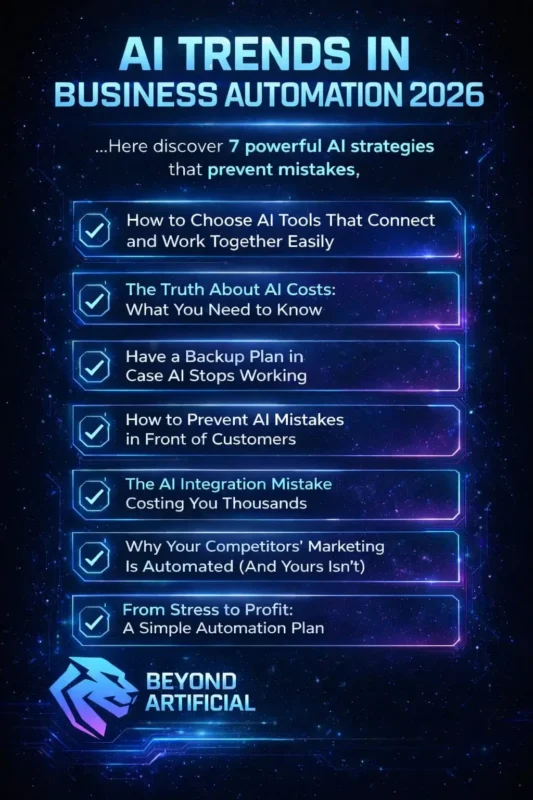
Keep reading to discover 7 powerful AI strategies that prevent mistakes, cut wasted hours, and finally give you control over your business. Stop stressing, start automating, and turn your chaos into cash.
1. How to Choose AI Tools That Connect and Work Together Easily
Imagine this nightmare: you buy three “amazing” AI tools, but they do not talk to each other. Suddenly, you are stuck copying data manually between systems, like it’s 1995, frustrating, right? The truth is, many businesses waste thousands on AI tools that create more problems than they solve. Here is how to avoid that:
Check for open APIs or built-in integrations with your existing software before buying.
Look for pre-built connectors to popular tools like Slack, Google Workspace, or your CRM. This saves you from expensive custom coding.
Consider an all-in-one platform (like HubSpot or Salesforce) where tools are made to work together from the start.
Ask for a live demo showing real data flowing between systems, not just slides.
Join user communities or forums to see if integrations actually work smoothly, so you do not end up with another expensive mistake.
Follow these steps, and your AI tools will finally start working together instead of adding more chaos to your day.
2. The Truth About AI Costs: What You Need to Know
Here is the harsh reality: that shiny AI tool advertised at “$99/month”? It can easily balloon to $500, or more, once you factor in hidden costs like API calls, extra storage, training, and those “must-have” premium features. And do not even get me started on the sneaky ongoing expenses, employee training, integration fees, data prep, and the consultant you will inevitably need when things break. You are not imagining it; they design pricing to trap you.
So here is how to fight back: always demand a full cost breakdown upfront, including limits, overage fees, and implementation costs. Test real usage with free trials or freemium versions before you commit. Add 20–30% extra for training and transition time, your team learning the system is real money and productivity lost. Finally, calculate your breakeven: compare total AI costs against the hours and dollars you will actually save. If the numbers do not add up in 6–12 months, walk away, no matter how shiny that sales pitch looks. You deserve AI that works for you, not against your wallet.
3. Have a Backup Plan in Case AI Stops Working
Picture this: it’s 2 AM on Black Friday, your AI chatbot is spitting nonsense at customers, your automated invoicing is frozen, and your business is grinding to a terrifying halt. Panic sets in as you realize you put all your eggs in the AI basket, and the “smart system” you trusted is failing you when it matters most. This is not a scare tactic; it’s reality. AI systems crash, APIs go down, and vendors sometimes vanish overnight, leaving businesses stranded and customers fleeing to competitors who actually work.
Here is how to avoid that nightmare: always document manual processes in clear, step-by-step guides so any team member can take over when AI fails. Set up real-time monitoring alerts to catch problems immediately, rather than discovering disasters hours later. Train your human staff to handle core functions manually; it might feel redundant, but when your AI collapses at the worst possible moment, they will be your lifeline. And finally, diversify your AI vendors for critical tasks so a single failure does not destroy everything.
Because the truth is, peace of mind is not just nice, it’s priceless. Your business deserves to survive, even when AI does not.
4. How to Prevent AI Mistakes in Front of Customers
Nothing destroys trust faster than your AI chatbot calling a loyal customer by the wrong name, suggesting strange products, or giving wrong information that makes your business look careless. One small AI mistake can undo years of relationship-building, driving customers straight to your competitors and damaging your reputation. The anxiety of “what if my AI messes up?” is real, but you can protect yourself.
Use a “human-in-the-loop” system, where AI handles routine tasks but escalates tricky or sensitive issues to real people. Test your AI with real-world scenarios, including unusual requests and difficult customers, before going live. Set confidence thresholds so that AI only responds when it’s highly certain; it hands the conversation to a human.
Finally, monitor AI interactions and retrain the system from mistakes, turning potential disasters into opportunities to build trust and improve customer experience.
5. The AI Integration Mistake Costing You Thousands
One of the most expensive mistakes businesses make is rushing to implement AI everywhere without a clear plan. The result? A messy jumble of disconnected tools that duplicate work, confuse employees, and drain your budget fast. Many companies waste $10,000–$50,000 a year on overlapping subscriptions and redundant features simply because they did not map out what they actually needed.
Feeling frustrated paying for five tools that do the same thing? You are not alone, and it’s completely avoidable. Start with a detailed process map of your operations, identifying where AI truly adds value before spending a dollar. Next, audit your existing software to uncover AI features you are already paying for but not using. Focus on one core AI platform that handles multiple functions, reducing costs and complexity. Finally, assign an “AI integration owner” to track all tools, prevent duplicates, and ensure everything works together.
With this approach, you will save money, streamline operations, and finally make AI work for you instead of against you.
6. Why Your Competitors’ Marketing Is Automated (And Yours Is not)
While youare staying up late crafting emails, scheduling posts one by one, and trying to personalize messages for hundreds of customers, your competitors are relaxing while AI does it all, sending perfectly timed emails, creating engaging content, and nurturing leads 24/7. The tough truth? They are reaching more customers with less effort, closing deals while you are stuck on the content hamster wheel.
You are not failing, you are just fighting with one hand tied behind your back while their AI does the heavy lifting. Here is how to catch up: start with an all-in-one marketing automation platform like HubSpot, Mailchimp, or ActiveCampaign to handle email sequences, social scheduling, and lead scoring automatically. Use AI writing assistants to generate multiple content variations in minutes, then add your personal touch. Set up behavioral triggers so emails are sent automatically based on actions like cart abandonment or website visits.
Finally, spend one afternoon mapping your customer journey and automating repetitive touchpoints. That single step can free up hundreds of hours each year to focus on growing your business instead of drowning in marketing busywork.
7. From Stress to Profit: A Simple Automation Plan.
Running your business can feel exhausting, like fighting a never-ending wildfire, but it does not have to. A simple 90-day automation plan can turn your chaos into smooth, profitable operations that practically run themselves. You do not need to automate everything at once or be a tech genius; you just need a clear roadmap that tackles your biggest pain points first. Imagine sleeping through the night knowing your business is humming along, making money, and delighting customers while you rest; that is totally achievable. Here is how:
Weeks 1–2: List all your repetitive tasks and highlight the top 3 that waste the most time or cause the most stress. These are your first automation targets.
Weeks 3–4: Pick one simple automation tool for your #1 pain point (like Calendly for scheduling or Zapier to connect apps) and get it working perfectly.
Month 2: Automate your second pain point while tracking the time and money saved from your first win; seeing results keeps you motivated.
Month 3: Scale your successes to other areas, train your team on the new workflows, and celebrate the freedom you have earned.
With this plan, your business starts working for you, not the other way around, and that victory is worth celebrating.
FREQUENTLY ASKED QUESTIONS(FAQs)
What is the 7-point strategy of AI?
The 7-point AI strategy is your roadmap to escape business chaos and finally take control. Start small by automating repetitive tasks, then improve customer service with AI, use predictive analytics to make smarter decisions, and leverage AI for marketing. Train your team, make sure your data is accurate, and track results before scaling up. Follow these steps in order, and in just 90 days, you can go from stressed-out and overwhelmed to running a smooth, profitable business where AI handles the grunt work while you focus on growth, strategy, and reclaiming your time.
What is the future of AI in business automation?
The future of AI in business automation is all about “agentic AI”, smart systems that do not just assist you but actually make decisions and handle entire workflows on their own, like a tireless employee who never sleeps. Imagine AI negotiating with vendors, managing your supply chain, running marketing campaigns from start to finish, and solving complex customer issues without human help. The bottom line: businesses that adopt these autonomous AI agents will move faster, operate with smaller teams, and leave manual processes, and their slower competitors far behind.
What are the 4 techniques of AI?
The 4 main AI techniques that power business automation are:
Machine Learning, AI that learns from data patterns to make smarter decisions.
Natural Language Processing (NLP) is AI that understands and responds to human language.
Computer Vision, AI that sees and analyzes images.
Robotic Process Automation (RPA) is AI that mimics human actions in software to get tasks done automatically.
These techniques are not just tech jargon; they are the engines behind chatbots handling customer complaints, systems predicting which leads will buy, invoices processing themselves, and inventory managing itself. Master even one of these, and you’ will leap ahead of competitors still stuck doing everything manually.
What are the 5 key principles of AI?
The 5 key principles of AI are:
Learning from Data: AI gets smarter over time by analyzing information.
Reasoning and Problem-Solving: AI makes logical decisions to solve problems.
Perception: AI understands text, speech, and images.
Natural Language Processing (NLP): AI communicates like a human.
Automation: AI performs tasks on its own without constant supervision.
Together, these principles transform your business from a manual grind into an intelligent system that thinks, learns, adapts, and improves automatically. Build your automation strategy around these five principles, and your business won’t just work faster; it will get smarter and more efficient every day, without you micromanaging every detail.
What are the 4 techniques of AI?
The 4 core AI techniques transforming businesses are Machine Learning (learning from experience), Deep Learning (recognizing complex patterns), Natural Language Processing (understanding human language), and Computer Vision (analyzing images and videos). These powers help AI predict sales trends, automate customer conversations, process documents instantly, and spot product defects faster than any human. Understand these four, and AI stops being a mystery; you will know which one solves your business problems and how to use it confidently.
How does AI improve efficiency in business?
Ever feel like you are running on a hamster wheel, working 12-hour days, but still falling behind as your to-do list grows out of control? That endless grind steals your sanity, your free time, and the joy you once had in your business. Here is the breakthrough: AI does not just speed things up, it removes the repetitive, soul-draining tasks that eat your time, giving you hours back to think, strategize, and grow.
Imagine cutting task time by 40–60%, spotting problems before they become expensive disasters, and finally having mental space to focus on what actually matters. AI turns you from an exhausted operator into a strategic leader who is in control, profitable, and enjoying business again.
AI supercharges efficiency by:
Automating repetitive tasks like data entry, scheduling, and reporting, freeing 15–20 hours per week.
Making fast, data-driven decisions that would take humans days or weeks.
Working 24/7 so your business keeps running while you rest or spend time with loved ones.
Eliminating human errors in routine tasks can cost thousands and damage credibility.
